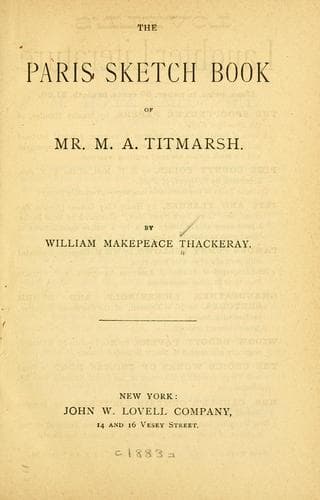
The Paris Sketch Book of Mr. M. A. TitmarshThackeray, William Makepeace
General
The Paris Sketch Book of Mr. M. A. Titmarsh
Thackeray, William Makepeace
Paris (France) -- Description and travel
“Your domestic ran straight forward, instead of taking to the woods, by
the side of the rood: this is very unlikely.” How does his worship
know? Can any judge, however enlightened, tell the exact road that a
man will take, who has just missed a coup of murder, and is pursued by
a man who is firing pistols at him? And has a judge a right to instruct
a jury in this way, as to what they shall, or shall not, believe?
“You have to run after an active man, who has the start of you: to jump
out of a carriage; to take your pistols; and THEN, your hammer. THIS IS
IMPOSSIBLE.” By heavens! does it not make a man’s blood boil, to read
such blundering, blood-seeking sophistry? This man, when it suits him,
shows that Rey would be slow in his motions; and when it suits him,
declares that Rey ought to be quick; declares ex cathedrâ, what pace
Rey should go, and what direction he should take; shows, in a breath,
that he must have run faster than Peytel; and then, that he could not
run fast, because the cloak clogged him; settles how he is to be
dressed when he commits a murder, and what money he is to have in his
pocket; gives these impossible suppositions to the jury, and tells them
that the previous statements are impossible; and, finally, informs them
of the precise manner in which Rey must have stood holding his
horse-cloth in one hand, his whip and pistol in the other, when he made
the supposed attempt at murder. Now, what is the size of a horse-cloth?
Is it as big as a pocket-handkerchief? Is there no possibility that it
might hang over one shoulder; that the whip should be held under that
very arm? Did you never see a carter so carry it, his hands in his
pockets all the while? Is it monstrous, abhorrent to nature, that a man
should fire a pistol from under a cloak on a rainy day?—that he should,
after firing the shot, be frightened, and run; run straight before him,
with the cloak on his shoulders, and the weapon in his hand? Peytel’s
story is possible, and very possible; it is almost probable. Allow that
Rey had the cloth on, and you allow that he must have been clogged in
his motions; that Peytel may have come up with him—felled him with a
blow of the hammer; the doctors say that he would have so fallen by one
blow—he would have fallen on his face, as he was found: the paper might
have been thrust into his breast, and tumbled out as he fell.
Circumstances far more impossible have occurred ere this; and men have
been hanged for them, who were as innocent of the crime laid to their
charge as the judge on the bench, who convicted them.
Public-domain text, read in full here on John Shaqi.
Reviews
Reviews
No reviews yet
Be the first to share your thoughts on this work.
Elsewhere in the archive
Join the Discussion
Join the discussion
Sign in to leave a comment or review.
Sign InorCreate an account