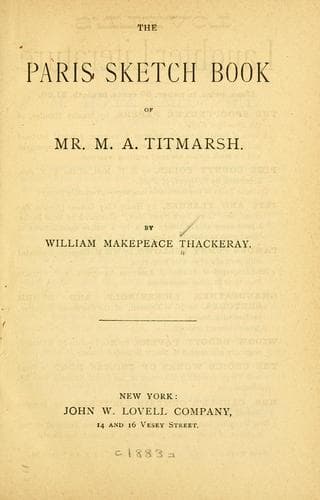
The Paris Sketch Book of Mr. M. A. TitmarshThackeray, William Makepeace
General
The Paris Sketch Book of Mr. M. A. Titmarsh
Thackeray, William Makepeace
Paris (France) -- Description and travel
Do not let us abuse poor old Louis on account of this monstrous pride;
but only lay it to the charge of the fools who believed and worshipped
it. If, honest man, he believed himself to be almost a god, it was only
because thousands of people had told him so—people only half liars,
too; who did, in the depths of their slavish respect, admire the man
almost as much as they said they did. If, when he appeared in his
five-hundred-million coat, as he is said to have done, before the
Siamese ambassadors, the courtiers began to shade their eyes and long
for parasols, as if this Bourbonic sun was too hot for them; indeed, it
is no wonder that he should believe that there was something dazzling
about his person: he had half a million of eager testimonies to this
idea. Who was to tell him the truth?—Only in the last years of his life
did trembling courtiers dare whisper to him, after much circumlocution,
that a certain battle had been fought at a place called Blenheim, and
that Eugene and Marlborough had stopped his long career of triumphs.
“On n’est plus heureux à notre âge,” says the old man, to one of his
old generals, welcoming Tallard after his defeat; and he rewards him
with honors, as if he had come from a victory. There is, if you will,
something magnanimous in this welcome to his conquered general, this
stout protest against Fate. Disaster succeeds disaster; armies after
armies march out to meet fiery Eugene and that dogged, fatal
Englishman, and disappear in the smoke of the enemies’ cannon. Even at
Versailles you may almost hear it roaring at last; but when courtiers,
who have forgotten their god, now talk of quitting this grand temple of
his, old Louis plucks up heart and will never hear of surrender. All
the gold and silver at Versailles he melts, to find bread for his
armies: all the jewels on his five-hundred-million coat he pawns
resolutely; and, bidding Villars go and make the last struggle but one,
promises, if his general is defeated, to place himself at the head of
his nobles, and die King of France. Indeed, after a man, for sixty
years, has been performing the part of a hero, some of the real heroic
stuff must have entered into his composition, whether he would or not.
When the great Elliston was enacting the part of King George the
Fourth, in the play of “The Coronation,” at Drury Lane, the galleries
applauded very loudly his suavity and majestic demeanor, at which
Elliston, inflamed by the popular loyalty (and by some fermented liquor
in which, it is said, he was in the habit of indulging), burst into
tears, and spreading out his arms, exclaimed: “Bless ye, bless ye, my
people!” Don’t let us laugh at his Ellistonian majesty, nor at the
people who clapped hands and yelled “bravo!” in praise of him. The
tipsy old manager did really feel that he was a hero at that moment;
and the people, wild with delight and attachment for a magnificent coat
and breeches, surely were uttering the true sentiments of loyalty:
Public-domain text, read in full here on John Shaqi.
Reviews
Reviews
No reviews yet
Be the first to share your thoughts on this work.
Elsewhere in the archive
Join the Discussion
Join the discussion
Sign in to leave a comment or review.
Sign InorCreate an account