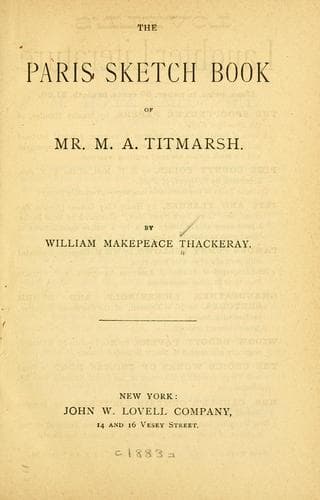
The Paris Sketch Book of Mr. M. A. TitmarshThackeray, William Makepeace
General
The Paris Sketch Book of Mr. M. A. Titmarsh
Thackeray, William Makepeace
Paris (France) -- Description and travel
which consists in reverencing these and other articles of costume. In
this fifth act, then, of his long royal drama, old Louis performed his
part excellently; and when the curtain drops upon him, he lies, dressed
majestically, in a becoming kingly attitude, as a king should.
The king his successor has not left, at Versailles, half so much
occasion for moralizing; perhaps the neighboring Parc aux Cerfs would
afford better illustrations of his reign. The life of his great
grandsire, the Grand Llama of France, seems to have frightened Louis
the well-beloved; who understood that loneliness is one of the
necessary conditions of divinity, and being of a jovial, companionable
turn, aspired not beyond manhood. Only in the matter of ladies did he
surpass his predecessor, as Solomon did David. War he eschewed, as his
grandfather bade him; and his simple taste found little in this world
to enjoy beyond the mulling of chocolate and the frying of pancakes.
Look, here is the room called Laboratoire du Roi, where, with his own
hands, he made his mistress’s breakfast:—here is the little door
through which, from her apartments in the upper story, the chaste Du
Barri came stealing down to the arms of the weary, feeble, gloomy old
man. But of women he was tired long since, and even pancake-frying had
palled upon him. What had he to do, after forty years of reign;—after
having exhausted everything? Every pleasure that Dubois could invent
for his hot youth, or cunning Lebel could minister to his old age, was
flat and stale; used up to the very dregs: every shilling in the
national purse had been squeezed out, by Pompadour and Du Barri and
such brilliant ministers of state. He had found out the vanity of
pleasure, as his ancestor had discovered the vanity of glory: indeed it
was high time that he should die. And die he did; and round his tomb,
as round that of his grandfather before him, the starving people sang a
dreadful chorus of curses, which were the only epitaphs for good or for
evil that were raised to his memory.
As for the courtiers—the knights and nobles, the unbought grace of
life—they, of course, forgot him in one minute after his death, as the
way is. When the king dies, the officer appointed opens his chamber
window, and calling out into the court below, Le Roi est mort, breaks
his cane, takes another and waves it, exclaiming, vive le Roi!
Straightway all the loyal nobles begin yelling vive le Roi! and the
officer goes round solemnly and sets yonder great clock in the Cour de
Marbre to the hour of the king’s death. This old Louis had solemnly
ordained; but the Versailles clock was only set twice: there was no
shouting of Vive le Roi when the successor of Louis XV. mounted to
heaven to join his sainted family.
Public-domain text, read in full here on John Shaqi.
Reviews
Reviews
No reviews yet
Be the first to share your thoughts on this work.
Elsewhere in the archive
Join the Discussion
Join the discussion
Sign in to leave a comment or review.
Sign InorCreate an account