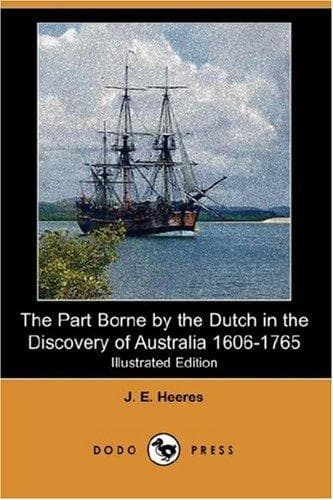
The Part Borne by the Dutch in the Discovery of Australia 1606-1765Heeres, J. E. (Jan Ernst)
History
The Part Borne by the Dutch in the Discovery of Australia 1606-1765
Heeres, J. E. (Jan Ernst)
Australia -- Discovery and exploration; Dutch -- Australia
[* That the Dutch identified Beach with the South-land discovered by them
in 1616, is proved by No. XI A of the Documents (p. 14).]
{Page v}
So far the information furnished by VAN LINSCHOTEN [*]. At the same time,
however, there were in the Netherlands persons who had other data to go
by. In 1597 CORNELIS WIJTFLIET of Louvain brought out his _Descriptionis
Plolomaicae augmentum_, which among the rest contained a chart on which
not only Java figured as an island, but which also represented New Guinea
as an island by itself, separated from Terra Australis. The question
naturally suggests itself, whether this chart [**] will justify the
assumption that the existence of _Torres Strait_ was known to WIJTFLIET.
I, for one, would not venture to infer as much, seeing that in other
respects this chart so closely reproduces the vague conjectures touching
a supposed Southland found on other charts of the period, that
WIJTFLIET'S open passage between New Guinea and Terra Australis cannot, I
think, be admitted as evidence that he actually knew of the existence of
Torres Strait, in the absence of any indications of the basis on which
this notion of his reposed. Such indications, however, are altogether
wanting: none are found in WIJTFLIET'S work itself, and other
contemporary authorities are equally silent on the point in question
[***].
[* See No. I of the Documents, with charts Nos. 1 and 2.]
[** COLLINGRIDGE, Discovery, p. 219, has a rough sketch of it.]
[*** Cf. also my Life of Tasman, p. 89, and Note 8.]
After this digression let us return to the stand-point taken up by the
North-Netherlanders who first set sail for the Indies in 1595. They "knew
in part" only: they were aware that they knew nothing with certitude. But
their mercantile interests very soon induced them to try to increase and
strengthen their information concerning the regions of the East. What
sort of country after all was this much-discussed New-Guinea, they began
to ask. As early as 1602 information was sought from the natives of
adjacent islands, but these proved to have "no certain knowledge of this
island of Nova Guinea" [*]. The next step taken was the sending out of a
ship for the purpose of obtaining this "certain knowledge": there were
rumours afloat of gold being found in New Guinea!
[* See No. II of the Documents.]
Public-domain text, read in full here on John Shaqi.
Reviews
Reviews
No reviews yet
Be the first to share your thoughts on this work.
Join the Discussion
Join the discussion
Sign in to leave a comment or review.
Sign InorCreate an account