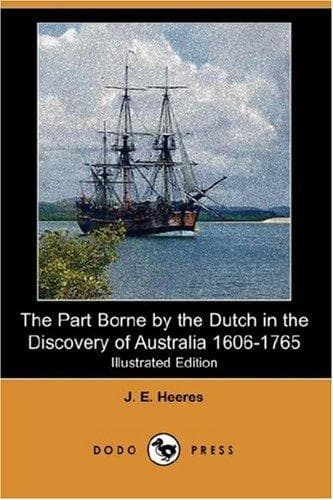
The Part Borne by the Dutch in the Discovery of Australia 1606-1765Heeres, J. E. (Jan Ernst)
History
The Part Borne by the Dutch in the Discovery of Australia 1606-1765
Heeres, J. E. (Jan Ernst)
Australia -- Discovery and exploration; Dutch -- Australia
Although in the sense thus indicated we must here speak of _acczdental_
discoveries on the west-coast, yet the Dutch authorities were fully aware
of the importance of such discoveries. As early as 1618, the Managers of
the E.I.C. were considering the possibility of "discovering the Southern
Lands in passing," and in a letter of September 9, 1620, with reference
to "the discovery of a vast land, situated south of Java...by the ship
Eendracht", etc., they expressly enjoined the G.-G. and Counc. to
dispatch a ship for the purpose of "resuming this work with some hope of
success." The lands discovered were to be mapped out, and efforts made to
ascertain "the situation and condition of the country, its productions,
what commodities it yields, the character of the natives, their mode of
life, etc."
The Managers had not preached to deaf ears: the direction of the
Company's affairs in India was at that time in the hands of Jan
Pieternoon Coen, who, being himself strongly disposed in favour of
extending the Dutch connections with the East [*], eagerly embraced the
idea thus suggested, as is proved by the instructions, dated September
29, 1622, for the ships Haring and Hazewind, "destined for the discovery
of the South-land". [**] Thus we see that one of the projects
contemplated by the Dutch authorities certainly was the dispatching of
ships also to the west-coast of Australia for the purpose of further
discovery and of definitely ascertaining the real state of affairs there.
[* See below.]
[** See below, No. XIII, B (pp. 18 ff.)]
But not for the purpose of further discovery exclusively, although this
continued to be "the principal end in view." The instructions of
September 29, 1622, also point to other motives that led the
Netherlanders to reckon also with regions to be first discovered, in
carrying out their colonial policy. The commanders of this expedition
were "specially to inquire what minerals, such as gold, silver, tin,
iron, lead and copper, what precious stones, pearls, vegetables, animals
and fruits, these lands yield and produce";--the commercial interests of
the E.I.C.--and what was more natural in the case of a trading
corporation?--were to take a foremost place. Wherever possible, also
political connections were to be formed, and the countries discovered
"to be taken possession of". The authorities were even considering the
idea of at some future date "planting colonies" in some of the regions
eventually to be discovered.
Public-domain text, read in full here on John Shaqi.
Reviews
Reviews
No reviews yet
Be the first to share your thoughts on this work.
Join the Discussion
Join the discussion
Sign in to leave a comment or review.
Sign InorCreate an account