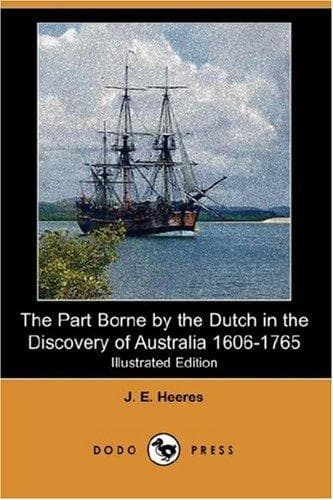
The Part Borne by the Dutch in the Discovery of Australia 1606-1765Heeres, J. E. (Jan Ernst)
History
The Part Borne by the Dutch in the Discovery of Australia 1606-1765
Heeres, J. E. (Jan Ernst)
Australia -- Discovery and exploration; Dutch -- Australia
Here we have the colonial policy of the E.I.C. of the period to its full
extent: commerce, increase of territory, colonies. And these ideas were
at the bottom of most of the voyages of discovery to the north-coast of
Australia before Tasman, and of Tasman's voyages themselves. The
celebrated voyage of the ship Duifken (1605-6) {Page xv} bears a
character of intentionality, and if we bear in mind that the same ship's
voyage of 1602 had for its professed object the extension of the
Company's mercantile connections, we need not be in doubt as to this
being equally the motive or one of the motives of the expedition on which
she was dispatched in 1605-6. We know, moreover, that New Guinea was then
reported "to yield abundance of gold." The three principles of colonial
policy just mentioned also underlay the voyage undertaken by Jan
Carstensz in 1623; for we know that this commander got the instructions
drawn up for the ships Haring and Hazewind, but not then carried into
effect, since these ships did not sail on their ordained expedition [*].
These principles are found set forth with more amplitude than anywhere
else in the instructions drawn up for Tasman and his coadjutors in 1642
and 1644 [**]. The voyages, then planned, were to be undertaken "for the
enlargement, increase and improvement of the Dutch East India Company's
standing and commerce in the East."
[* See below, p. 21, Note 1.]
[** See these instructions in my Life of Tasman, pp. 131 ff. and 147 ff.]
In the instructions for Tasman's voyage of 1644 the G.-G. and Counc.,
who drew them up, could still refer to "the express commands of the
'Heeren Maijoores" [*] to "attempt the discovery of Nova Guinea and other
unknown Eastern and Southern lands." And it is a fact certainly, that in
the first half of the seventeenth century the Governors-General who
planned these exploratory voyages were in their endeavours supported by
the Managers of the E.I.C. in the mother country [**]: it was especially
Jan Pieterszoon Coen (1619-1623 and 1627-1629), Hendrik Broulwer
(1632-1636) and Antonio van Diemen (1636-1645), who were most efficiently
backed in their efforts for this purpose by their principals at home.
Among these Governors-General Van Diemen holds the foremost place as
regards the furtherance of discoveries by Netherlanders in the Far East:
in the Pacific and on, "the mainland coasts of Australia." It is, with
complete justice, therefore, that a foreign author mentions the name of
Van Diemen as "a name which will ever rank among the greatest promotors
of maritime discovery".[***]
[* Meaning the Managers of the E.I.C.]
[** See also the instructions for the voyage of 1636, p. 64 _infra_.]
Public-domain text, read in full here on John Shaqi.
Reviews
Reviews
No reviews yet
Be the first to share your thoughts on this work.
Join the Discussion
Join the discussion
Sign in to leave a comment or review.
Sign InorCreate an account