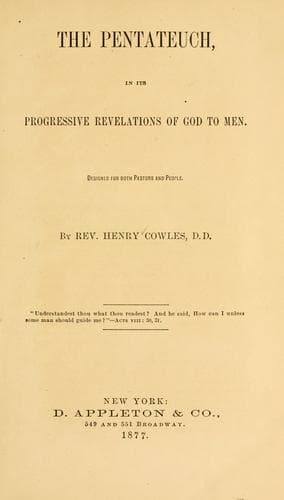
The Pentateuch, in Its Progressive Revelations of God to MenCowles, Henry
Religion
The Pentateuch, in Its Progressive Revelations of God to Men
Cowles, Henry
Bible. Pentateuch -- Criticism, interpretation, etc.
It is a matter of some interest to know that this remarkable record
of the birth of the great nations of antiquity is perfectly sustained
by the universal history of all subsequent ages. Whether Chaldean
or Phenician, Egyptian or Arabian, Greek or Roman, Mongol or Tartar,
Indo-Germanic, Celtic, Belgic or Briton――all find the germ of their
nationality in this wonderful chapter, and all concur to swell and
substantiate the proof that the human race sprang from Noah and that we
have no occasion to look for pre-Adamic men or for tribes that escaped
the flood and have no pedigree among the sons of Noah. While it was
never the purpose of divine revelation to give to any great extent
the universal history of the race, it is proper to note that what
it does give bears the divine stamp of truth. All historic science
does it homage. All the light that comes up from the comparative
study of the languages of the race helps us still to follow the track
of the emigrating tribes as they diverged from the ancient home of
Noah’s family. The Science of Ethnography begins with this chapter of
inspiration, Gen. 10.
* * * * *
4. _Babel and the confusion of tongues._
Gen. 11: 1–9 records a very remarkable event, of far reaching
consequences toward the geographical diffusion of the race. Up to this
point there was but one language――as the record has it――“_one lip and
one set of words_,” “lip” being (perhaps) used for the mode of speaking,
including pronunciation and possibly inflection; while words are the
_matter_ of language, the roots or ground-forms. The fact that the
latter have been far less variable than the former, appearing to some
extent in all subsequent ages throughout all the diversities of human
tongues, favors this distinction.
Migrating from the Armenian hill country where the ark rested, Noah’s
posterity reached the fertile plain of Shinar, halted there, and set
themselves to the building of a magnificent and lofty tower. There
being no stone at hand, they prepared brick, not sun-dried after the
common Oriental method, but thoroughly burned for greater durability.
As both consequence and proof of this durability, the supposed ruins of
this great tower, known as “Birs Nimrood” [tower of Nimrod] are still
extant within the area of ancient Babylon, silently witnessing alike to
the labors of those fathers of the nations before their dispersion, and
to the truthfulness of this sacred record.
Public-domain text, read in full here on John Shaqi.
Reviews
Reviews
No reviews yet
Be the first to share your thoughts on this work.
Elsewhere in the archive
Join the Discussion
Join the discussion
Sign in to leave a comment or review.
Sign InorCreate an account