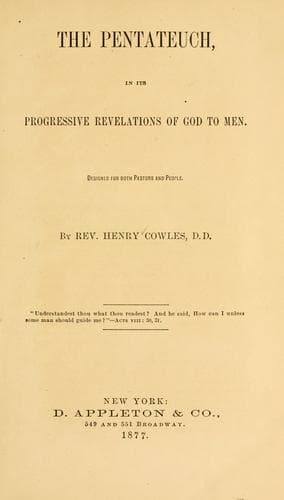
The Pentateuch, in Its Progressive Revelations of God to MenCowles, Henry
Religion
The Pentateuch, in Its Progressive Revelations of God to Men
Cowles, Henry
Bible. Pentateuch -- Criticism, interpretation, etc.
A very extraordinary case of the wresting of Scripture to make it
justify crime――so great a crime as the enslaving of men――is the attempt
to force from this prophecy concerning Canaan a vindication of the
enslaving of Africans by Americans. The wresting appears in these
two broad facts:――(a.) That the Africans were not Canaanites, and
therefore the prophecy said nothing about the negro race. Admitting for
argument’s sake that it justified the enslaving of Canaanites, it did
not in the least justify the enslaving of African negroes.――――(b.) If
the passage had named the African negro instead of the Canaanite, even
then a prediction _of what shall be_ might fall very far short of being
a command as to what man _ought to do_. Prophetic predictions of war
form not the least justification of war――fall utterly short of a divine
command enjoining man’s duty. Predictions of the Savior’s death could
never justify his murderers.
* * * * *
3. _The genealogy of the great historic nations._
In Gen. 10 the Bible for once departs from its usual method and gives
a chapter of _universal history_――the only one. Elsewhere it traces the
history of the one nation which had “the oracles of God,” and in later
ages, of the Christian church, touching the nations of the outside
world only as they come into relations to the seed of Abraham or to
the kingdom of Christ. But here we see the sons of Noah branching out
to people the countries of the great Eastern Continent and to found
the old historic nations of the earth.――――Japheth whom Prophecy was
to “_enlarge_” (Gen. 9: 27) furnished the tribes from which grew the
great nations of Northern and Eastern Asia and for the whole of Europe.
At first they occupied the maritime regions bordering on the Caspian,
Black and Mediterranean Seas, spoken of here as “the isles of the
Gentiles”――conforming to the Hebrew usage which called all maritime
countries “isles.”――――Next we have the sons of Ham, among whom were
Nimrod, the builder of Babel; Mizraim with his seven sons who himself
gave name to Egypt; Canaan whose posterity long held Palestine, and
several names which appear either in the cities or the tribes of the
valley of the Euphrates and of Arabia.――――Shem seems to have shared
with Ham the possession of the great fertile basin of the Euphrates and
the Tigris――the cradle of the race――together with portions of Arabia
and in general of South-western Asia.
Public-domain text, read in full here on John Shaqi.
Reviews
Reviews
No reviews yet
Be the first to share your thoughts on this work.
Elsewhere in the archive
Join the Discussion
Join the discussion
Sign in to leave a comment or review.
Sign InorCreate an account