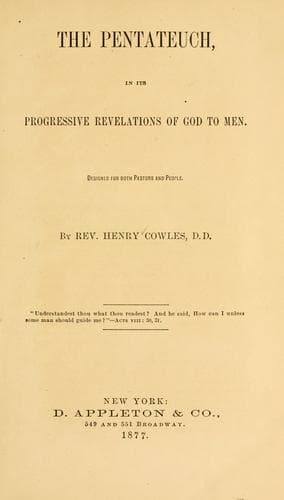
The Pentateuch, in Its Progressive Revelations of God to MenCowles, Henry
Religion
The Pentateuch, in Its Progressive Revelations of God to Men
Cowles, Henry
Bible. Pentateuch -- Criticism, interpretation, etc.
3. Next, after his magnanimous bearing toward Lot (13: 7–9, 14–18) in
which he seemed ready to waive all claim to any territory Lot might
choose to occupy. The Lord bade him lift up his eyes toward every
point of the compass, all round about and reiterated his grant of the
whole――“All the land which thou seest to thee will I give it and to thy
seed forever.” Also, that his seed should be as the dust of the earth.
His generous magnanimity toward Lot in nowise damaged his standing with
God or his rights in the goodly land of promise.
4. A yet richer scene of divine manifestation followed Abram’s rescue
of Lot from the plundering horde of the great Eastern kings (Gen. 15).
The first words were significant and precious: “Fear not, Abram; I
am thy shield and thine exceeding great reward.” Abram knew enough
of human nature and of the resentful, lawless spirit of those warlike
kings to see that he was exposed to their vengeance and that they might
return any day with more military force than his household could muster.
It was therefore at once timely and kind in the Lord to meet him at
this point with this comforting assurance: “Fear not; I am thy shield”;
I stand between thee and those vengeful foes: my strong arm shall be
a wall of fire round about thee. Moreover Abram had nobly refused to
appropriate to his personal use even a thread or a shoe-latchet of the
booty brought back from his routed enemies――whereupon the Lord said,
“I will be thine exceeding great reward.”――――Truly when a man’s ways
please the Lord, he not only keeps his enemies at peace with him but
makes all things go well.――――On this re-appearance the Lord promised
him a son more distinctly than ever before, and posterity as the
stars in number. Here it is said definitely――“Abraham believed God and
God counted it to him for righteousness.” His faith pleased God, and
because of it, God accepted him and he stood as one who is “_all right_
before God.”――――Remarkably the Lord at this time identified himself to
Abraham as the same God who had appeared to him in his fatherland and
called him forth into Canaan and said, This is the very land I then
promised to give thee; to which Abraham replied (v. 8), “Whereby shall
I know that I shall inherit it”? At once the Lord proceeded to ratify
his covenant in the usual Oriental manner. A heifer, a she-goat and
a ram――one from each species commonly used in sacrifice――are brought
forward; each is cut into two parts; the parts are laid asunder; a
turtle-dove and a young pigeon, also used for sacrifice in certain
contingencies, were added but not cut in two. Then when night came on,
a deep sleep fell upon Abraham and the Lord gave him in vision certain
prophetic views of his posterity; and ratified the covenant by passing
(in the symbol of fire and smoke) between the severed parts of the
sacrificial animals. Of this method of ratifying covenants we have
historical traces in Jer. 34: 18–20. We have also early and decisive
Public-domain text, read in full here on John Shaqi.
Reviews
Reviews
No reviews yet
Be the first to share your thoughts on this work.
Elsewhere in the archive
Join the Discussion
Join the discussion
Sign in to leave a comment or review.
Sign InorCreate an account