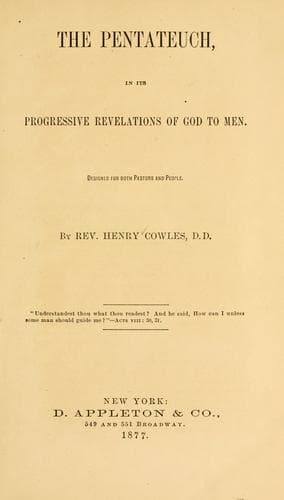
The Pentateuch, in Its Progressive Revelations of God to MenCowles, Henry
Religion
The Pentateuch, in Its Progressive Revelations of God to Men
Cowles, Henry
Bible. Pentateuch -- Criticism, interpretation, etc.
In many respects this covenant made Abraham and his posterity a
peculiar people, discriminating broadly between them and every other
nation, and accumulating the blessings of God upon them in no stinted
measure. It might be apprehended that such exclusiveness would beget
bigotry, national pride and self-righteousness; but, with wisest
forethought, the Lord put into this covenant one counteracting element
of great power, viz. that _he ordained them to be a blessing to all the
nations of the earth_. “In thee and in thy seed shall all the nations
of the earth be blessed.” It was never the thought of God that the
Hebrew people should live to themselves and for themselves――should
garner their own store-house full of heavenly blessings and leave
all other peoples to shift for themselves as best they might. No;
God’s plan contemplated the culture in their souls of the broadest
benevolence, and this, pressed into service by a sense of largest
responsibility to meet the revealed purposes of God as to their work.
Into this great system which made them his peculiar people, he put,
openly and clearly, the germinal idea of a salvation to be provided for
the wide world――this covenant people to be the almoners of all these
blessings to the otherwise benighted and perishing nations. Properly
understood and duly regarded, this germinal idea would have developed
in their hearts and lives the true missionary spirit, would have given
at once both breadth and depth to their piety, would have made them
feel that God had great thoughts of mercy for the whole race of man,
and had honored them as his ministers in giving this salvation to every
creature. At the very least here was opened a thoroughly rich field for
prayer, the broadest scope for real sympathy with the benevolence of
the Great Father of all the nations and a powerful antidote against the
narrow exclusiveness which might otherwise have shrunk and shriveled
their piety and narrowed their aspirations to themselves and their
land. How often in the heart of the good men of later times――the men
like Moses, Samuel, David, Isaiah,――must the kindling thought have been
sprung by this great germinal promise――_When shall these things be?_
When shall the full fruitage of these great promises be realized? What
have we to do to hasten the coming of that sublime consummation?
* * * * *
It remains to speak more definitely of the promises made to Abraham _as
including the great Messiah_.
In this as in most other Messianic prophecies, the argument is
threefold;
(1) The language obviously _admits_ the Messiah, _i. e._ may be
construed without violence to apply to him, or at least to _include_
him:
(2) Its meaning is so broad that it _must_ include him; the blessings
are too great to be supposed possible without him――apart from him: and
(3) The inspired writers of the New Testament found the Messiah in this
prophecy.
Public-domain text, read in full here on John Shaqi.
Reviews
Reviews
No reviews yet
Be the first to share your thoughts on this work.
Elsewhere in the archive
Join the Discussion
Join the discussion
Sign in to leave a comment or review.
Sign InorCreate an account