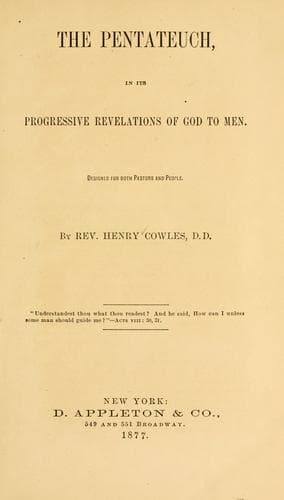
The Pentateuch, in Its Progressive Revelations of God to MenCowles, Henry
Religion
The Pentateuch, in Its Progressive Revelations of God to Men
Cowles, Henry
Bible. Pentateuch -- Criticism, interpretation, etc.
They are getting ready now for home; their sacks are filled with
corn again, and again the money is put back into each sack’s mouth,
and worst of all, Joseph’s silver cup is slipped into the mouth of
Benjamin’s sack. Ere they are fairly out of the city Joseph posts his
steward after them, abruptly charging them with having ungratefully
stolen his lord’s silver cup. Consciously innocent and deeply indignant,
they are rash enough to say――Let the man in whose sack it is found
die, and take all the rest of us for slaves! How were they amazed
and overwhelmed when the cup was found in Benjamin’s sack! They rent
their clothes in bitterness of heart, and all return to the city. Judah
comes to the front here; it is “Judah and his brethren” who come to
Joseph’s house, and Judah who makes the plea in behalf of Benjamin.
The historian is careful to say again that when they met Joseph “they
fell before him on the ground.” He also remarks that Joseph was yet
in his house, having remained there ever since the caravan left in the
early morning, too full of thought on this subject to turn to any other
business.――――Now he expects to learn how they feel toward Benjamin and
toward their aged father. He must be sure they are all right on these
points before he lifts the vail and shows them himself.――――They are
brought back as criminals before him. With a sternness that is not at
all in his heart but in his assumed manner only, he says――What deed
is this that ye have done? Were ye not aware that I have the power of
positive and certain divination?――――Judah is in deep perplexity――but he
speaks frankly: “What shall we say unto my lord? or how shall we clear
ourselves? God hath found out the iniquity of thy servants”――which
words can not, it would seem, refer to any iniquity in the matter
of the silver cup, but must have referred to the long past crime of
the brethren toward Joseph. He can not say less than that they will
all become the slaves of Joseph, all including even Benjamin.――――No,
replies Joseph; I want only the guilty man, Benjamin; all the rest of
you may go in peace to your father!――――Now the crisis so long dreaded
has come. A terrible responsibility falls upon Judah. With wonderful
simplicity, with most touching filial affection toward his father, and
with masterly skill he rises to the moral sublimity of the occasion. He
comes near to Joseph and begins his great plea. Every reader must study
it. We shall need to go far to find more touching eloquence, a more
masterly setting forth of the facts of the case including the whole
story from the beginning to the end. The case of the aged father and of
his two younger sons left him by his best beloved wife――put in the aged
patriarch’s own words――ran thus: “Ye know that my wife bear me two sons,
and the one went out from me, and I said――Surely he is torn in pieces,
and I have not seen him since; and if ye take this also from me, and
mischief befall him, ye shall bring down my gray hairs with sorrow
to the grave.
Public-domain text, read in full here on John Shaqi.
Reviews
Reviews
No reviews yet
Be the first to share your thoughts on this work.
Elsewhere in the archive
Join the Discussion
Join the discussion
Sign in to leave a comment or review.
Sign InorCreate an account