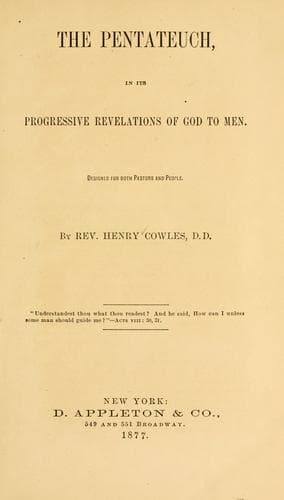
The Pentateuch, in Its Progressive Revelations of God to MenCowles, Henry
Religion
The Pentateuch, in Its Progressive Revelations of God to Men
Cowles, Henry
Bible. Pentateuch -- Criticism, interpretation, etc.
Now therefore when I come to thy servant my father and
the lad be not with us; (seeing that his life is bound up in the lad’s
life)――when he shall see that the lad is not with us he will die; and
thy servants will bring down the gray hairs of our father with sorrow
to the grave. I said to him, If I bring not Benjamin back, I will bear
the blame forever. Now therefore I pray thee, let me abide instead
of Benjamin, the bond-servant of my lord, and let him go back to his
father. For how shall I go to my father and the lad be not with me?
Lest peradventure I see the evil that shall come on my father.”――――This
was more than Joseph could bear. He could refrain himself no longer;
the tears would come; the swelling emotions must have vent. Joseph
cried: “Have every man away from me save these men of Canaan.”
The proof of their love to their aged father and to Benjamin is
unmistakable; Joseph is satisfied. They are penitent for their long
past crime against him, and he can therefore at length break the secret
and show himself their long lost brother! How do their ears tingle
as they hear him say――“I am Joseph: Doth my father yet live?”――――The
first shock is almost stunning: they can not answer him, for they are
troubled at his presence. More kind words and the kindest possible
manner are now in place. “Joseph said to his brethren, Come near to
me, I pray you; and they came near.” Again he says――“I am Joseph, _your
brother_, whom ye sold into Egypt.” Then with a turn which evinces the
exquisite tenderness of his heart, he begs them “not to be grieved nor
angry with themselves;” but to think rather of the design of God in
permitting and providentially shaping this wonderful series of events.
“God did send me before you to preserve life. There are five more
years of famine yet to come; God sent me before you to preserve you a
posterity in the earth and to save your lives by a great deliverance.
So now it was not you that sent me hither, but God.” The best thing
he could say under just those circumstances to soothe their mind, to
assure them of his full forgiveness and to give them consolation in
place of the agitation, fear, and remorse that so nearly overwhelmed
their spirits.
Public-domain text, read in full here on John Shaqi.
Reviews
Reviews
No reviews yet
Be the first to share your thoughts on this work.
Elsewhere in the archive
Join the Discussion
Join the discussion
Sign in to leave a comment or review.
Sign InorCreate an account