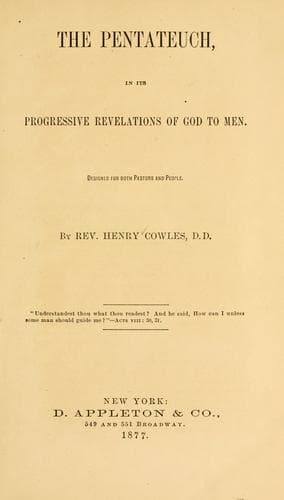
The Pentateuch, in Its Progressive Revelations of God to MenCowles, Henry
Religion
The Pentateuch, in Its Progressive Revelations of God to Men
Cowles, Henry
Bible. Pentateuch -- Criticism, interpretation, etc.
Arrangements for the future are soon made. Joseph assures them that the
best of Egypt’s land shall be given them, and insists that they hasten
home and bring their aged father and their little ones――every thing
they have――down to Egypt, because five more years of famine are to
follow. Egyptian wagons――unknown to Jacob’s household――are sent, and
the brethren are hastened off. Were they not a happy band? The great
agony of fear is past; the surgings of anxiety and solicitude have
ceased; the pungent convictions of that dread crime long ago against
their younger brother have done their work, and wrought out “the
peaceable fruits of righteousness.” This is a wonderful crisis in
their life history. Let us hope that most if not all of them found God
through these fiery trials and these penitent tears!
They are home again. The first thing is to break this strange secret
to their father. They make just two points: “Joseph yet alive;” “Joseph
Governor over all the land of Egypt.” It was too much――was too good
to be believed. The English version has it, “Jacob’s heart fainted.”
Better――“Jacob’s heart _remained cold_, for he believed them not.” It
stirred no joyous and warm emotions, for he could not believe it. But
when they told him all the words of Joseph, and especially when he saw
the wagons which Joseph had sent to carry him, then his spirit rose;
his heart waxed warm; he said: “_It is enough_; Joseph my son _is_ yet
alive; I will go and see him before I die.”
Beersheba, the old home of his father Isaac, lay on his route. He
stopped there and offered sacrifice to the God of his father Isaac.
The night following the Lord met him in vision, saying, “I am thy God
and the God of thy father; fear not to go down into Egypt, for I will
there make of thee a great nation: I will go down with thee into Egypt
and will bring thee up again; and Joseph shall put his hand upon thine
eyes”――_i. e._ to close them in death.――――How tenderly appreciative
of the circumstances and of Jacob’s need was this vision of Beersheba!
Such are God’s blessed ways with his children. He can not send them
into scenes of special danger or of critical interest, without some
special manifestations of his presence.
II. We are to notice _the hand of God_ in this history in its twofold
bearings:
1. As active in the sufferings and moral trial of the virtuous;
2. As manifested in his overruling control of the wicked to bring forth
from their wickedness abounding good.
1. As active in the sufferings and moral trial of the virtuous.――――The
most cursory reader of this story will see in it a striking case of
the sufferings of innocence. Joseph, envied and hated for no fault
of his; coming near to being murdered by his own brothers, and really
sold into slavery――a slavery prospectively life-long and in a distant,
unknown land; torn away from every thing dear in _home_, at the age
of seventeen:――this surely was innocence subjected to the sternest
suffering.
Public-domain text, read in full here on John Shaqi.
Reviews
Reviews
No reviews yet
Be the first to share your thoughts on this work.
Elsewhere in the archive
Join the Discussion
Join the discussion
Sign in to leave a comment or review.
Sign InorCreate an account