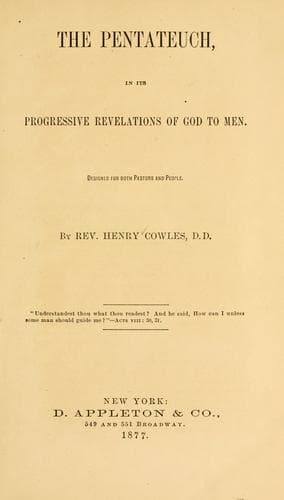
The Pentateuch, in Its Progressive Revelations of God to MenCowles, Henry
Religion
The Pentateuch, in Its Progressive Revelations of God to Men
Cowles, Henry
Bible. Pentateuch -- Criticism, interpretation, etc.
How do such things happen under the government of God? When they do
happen, _what do they prove_?
a. Negatively: They prove that all the suffering in this world _can not
be retribution for sin_. There may be great suffering which can not in
any true sense be the punishment of great crime. The greatest sufferers
are not necessarily and always the greatest sinners. Suffering is
not graduated to crime.――――This lesson Job’s three friends were slow
to learn. Even Job himself seems not to have learned it thoroughly,
but was groping toward it, under the lessons of his own conscious
experience. It may not be amiss to suggest here that Job and his
friends reasoned _without the light_ which this history of Joseph would
have given them if they had ever heard or read it. They either lived
_before Joseph_, or too remote from these scenes to hear or in any way
learn the lessons they teach.
b. Positively this case illustrates some of the ends which God aims to
secure by permitting the sufferings of the good; _e. g._ to discipline
them to patience under suffering, and to trust in God in the midst of
darkness and in spite of it. Joseph’s slavery and prison-life in Egypt
would have been simply miserable without this patience and this trust
in the Lord his God. Suppose he had given himself up to fretting and
chafing and dashing his head against the strong walls of his prison and
to wrenching off the fetters with which they “hurt his feet” (Ps. 105:
18);――What could have come of such adjustment of one’s self to dark
providences? Certainly not the sweet and blessed discipline which he
did in fact get from his afflictions; certainly not the favor and the
blessing of his God. Every thing in the future as before his eye was
dark enough; but he knew there was a God of loving kindness above――a
God who made no mistakes, yet whose purposes were often too deep for
afflicted man to fathom, and therefore a God whom his children should
learn to trust as certainly doing _all things_ well.
Again; the case serves to reveal God’s pity and his love in that
he _goes with_ his children into their slave-life and into their
prison-life with such smiles of favor, such tokens of his presence,
as may well make them joyful in the most terrible affliction. As Paul
and Silas prayed and sang praises within the cold, desolate walls of
a prison while yet smarting under the Roman scourge, and with perhaps
some prospect of sufferings more severe when another day should dawn;
so Joseph found the Lord with him when he reached Egypt a slave;
with him when cast into prison because he virtuously repelled a foul
temptation to crime. God was there, proving to his servant Joseph that
no surroundings are so dark that God’s manifested presence will not
make them light――that no sufferings and no bereavements are so severe
that God can not throw his smile upon the sufferer and fill his soul
with overflowing joy!
Public-domain text, read in full here on John Shaqi.
Reviews
Reviews
No reviews yet
Be the first to share your thoughts on this work.
Elsewhere in the archive
Join the Discussion
Join the discussion
Sign in to leave a comment or review.
Sign InorCreate an account