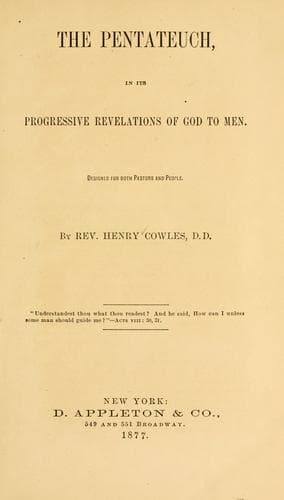
The Pentateuch, in Its Progressive Revelations of God to MenCowles, Henry
Religion
The Pentateuch, in Its Progressive Revelations of God to Men
Cowles, Henry
Bible. Pentateuch -- Criticism, interpretation, etc.
Yet again; this lesson teaches that God uses means apparently rough
and stern to prepare his servants for higher responsibilities and more
signal blessings. We can not say what Joseph would have been if he had
remained in the bosom of his doting father’s home through all those
years from seventeen to thirty, instead of being in God’s school of
suffering and trial; but it is safe to say that he made rapid strides
forward in this school of God――in his knowledge of human nature; in his
quick and manifest sympathy with every one in trouble; in his skill to
gain the confidence of those about and above him; in his capacity for
business; and not least in his living piety and his humble walk with
God. His surroundings threw him roughly upon his own resources, and
at the same time sweetly upon God’s resources; and in consequence he
rose, as few men have even been fit to rise, from slave-life and from
prison-life, to be the actuary of a great kingdom――the almoner of bread
and of life to the nations of the then civilized world; and also to
become one of the most exalted and spotless characters of all history.
Are not the ways of God truly wonderful?
* * * * *
_The ways of God toward Jacob_ must not be overlooked. We need not
debate the question how far his sufferings were those of innocence,
and how far he was criminally responsible for the lack of moral culture
and the power of fearful depravity in his sons. Be this as it may, it
was hard for him to lose Joseph――the one son who was a comfort to his
heart among so many who were quite otherwise. Even after thirteen years
his heart seems still to be sore with that great sorrow, so that when
his ten sons say that Benjamin must go with them to Egypt, he exclaims,
“All these things are against me”! And when at length he is compelled
to consent, his words indicate that he bows to an inexorable fate
rather than yields in sweet trust to a divine hand believed to be
wise and kind, though utterly and inexplicably mysterious;――“If I am
bereaved of my children, I am bereaved.”
Public-domain text, read in full here on John Shaqi.
Reviews
Reviews
No reviews yet
Be the first to share your thoughts on this work.
Elsewhere in the archive
Join the Discussion
Join the discussion
Sign in to leave a comment or review.
Sign InorCreate an account