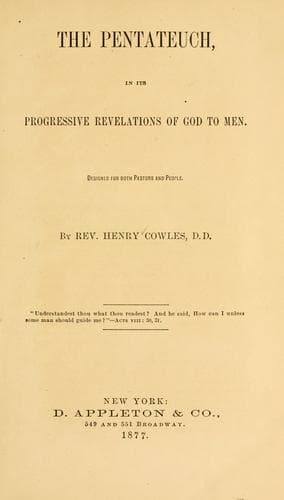
The Pentateuch, in Its Progressive Revelations of God to MenCowles, Henry
Religion
The Pentateuch, in Its Progressive Revelations of God to Men
Cowles, Henry
Bible. Pentateuch -- Criticism, interpretation, etc.
6. Joseph’s arraignment of his brethren――“Ye are spies; to see
the nakedness of the land are ye come”――suggests an inquiry into
the relations of Egypt to foreign powers. The suspicions of Joseph
obviously assume a consciousness of great liability to foreign invasion.
Such was the fact; and the reasons for it will readily appear. We
have only to think of the powerful tribes scattered over vast Arabia,
the Hittites and other tribes of Canaan and of the regions North and
East――all stalwart men, all poor and subsisting on precarious supplies,
yet possessed of fleet animals――horses, dromedaries, camels――with which
they were able to move masses of men with great celerity. Let such men
see the tempting bait of corn in plenty in Egypt, and the marvel is
how Egypt could protect herself against sudden and formidable invasion.
The monuments of her early history testify to her long and bloody wars
with the Hittites and other tribes of Western Asia, often carrying the
war into their country as a wiser policy no doubt than to stand behind
her own walls on the defensive. Suffice it to say here that when those
Asiatic countries were famishing for bread and it was well known there
was corn enough in Egypt, the suspicion expressed by Joseph that those
ten men were spies was not only natural but perhaps even a necessary
measure of policy to satisfy the Egyptians. _They_ must naturally
apprehend danger though _he_ might personally know that these men were
harmless.
7. Sacred history drops this incidental remark――“For every shepherd
is an abomination to the Egyptians” (Gen. 46: 34). To some extent
this feeling was a natural outgrowth of their relations to the nomadic
tribes of South-western Asia――to which we have recently referred. But
there is some reason to suppose among them a certain special antipathy
against the sheep, more intense than against any other domestic animal
unless swine be an exception. They had so much respect for the cow
that they made her and her species objects of worship. Although they
attained great skill in the manufacture of linen, cotton, and silk,
I meet with no allusion to wool. Woolen cloths are never found upon
Egyptian mummies; linen and cotton were used.――――Some writers have
supposed that shepherds were held in special abhorrence because their
country had been conquered and ruled by a dynasty of shepherd kings
from the North-east; but the precise date of their invasion and of
their rule over Egypt is very much in doubt.
Public-domain text, read in full here on John Shaqi.
Reviews
Reviews
No reviews yet
Be the first to share your thoughts on this work.
Elsewhere in the archive
Join the Discussion
Join the discussion
Sign in to leave a comment or review.
Sign InorCreate an account