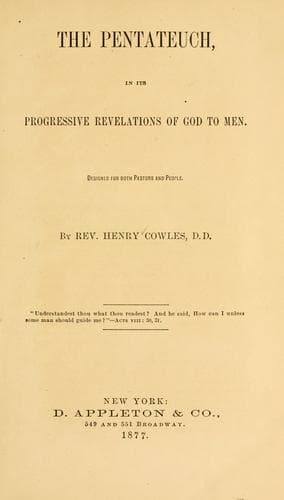
The Pentateuch, in Its Progressive Revelations of God to MenCowles, Henry
Religion
The Pentateuch, in Its Progressive Revelations of God to Men
Cowles, Henry
Bible. Pentateuch -- Criticism, interpretation, etc.
8. Both Joseph and his father were embalmed after death (Gen. 50: 2,
3, 26)――a service performed by the physicians. The antiquities of Egypt
furnish most conclusive testimony to their skill in this art――a skill
far surpassing that of any other people known to history. Great numbers
of those embalmed bodies (“mummies”) have been found in Egyptian tombs
within the present century, in perfect preservation. On this point the
coincidences between sacred and profane history are striking.――――The
practice was very ancient, some mummies bearing the date of the oldest
kings. It was performed by a special class of physicians. In harmony
with Moses, Herodotus and Diodorus state that the embalming process
occupied forty days; the entire period of mourning seventy. Classic
authorities give accounts similar to those in Gen. 50 of great mourning
for the dead. The monuments contain representations to the same
effect. Funeral trains, processions, of such sort as Gen. 50 records,
are represented abundantly in the oldest tombs at Elithias, also
at Sagguarah, at Gizeh, and at Thebes. (Hengstenberg’s Egypt and
Moses, pp. 70–78).――――A coincidence so minute as this is noticed; that
mourners forbore to shave their hair or beard; but none might appear
♦before the king unshorn. Consequently we observe that in the mourning
scene of Gen. 50, Joseph does not come before the king in person but
“spake unto the house of Pharaoh” requesting them to speak in his
behalf to the king (Gen. 50: 4–6).
Quite in contrast with the usual oriental custom, women were exempt
from seclusion and moved in society with apparently entire freedom.
This appears in the family of Potiphar. The ancient sculptures and
paintings found in their tombs give a very full view of the domestic
life of the ancient Egyptians, no point of which is more striking than
the high social position of woman and the entire absence of the harem
system of seclusion. “The wife is called the lady of the house.” (See
Smith’s Bible Dictionary, p. 677). According to the monuments the women
in Egypt lived under far less restraint than in the East, or even in
Greece. Wilkinson’s Egypt is full of testimony to this point (Vol. II.,
p. 389). Hengstenberg’s Moses, p. 24.
Sad to say there is abundant evidence from profane sources of a very
lax morality among married women――of which the history of Joseph in
Potiphar’s house is an illustration. Herodotus gives a fact in point:
“The wife of one of the earliest kings was untrue to him. It was a long
time before a woman could be found who was faithful to her husband.
When at last one was found, the king took her without hesitation for
his wife.”
Public-domain text, read in full here on John Shaqi.
Reviews
Reviews
No reviews yet
Be the first to share your thoughts on this work.
Elsewhere in the archive
Join the Discussion
Join the discussion
Sign in to leave a comment or review.
Sign InorCreate an account