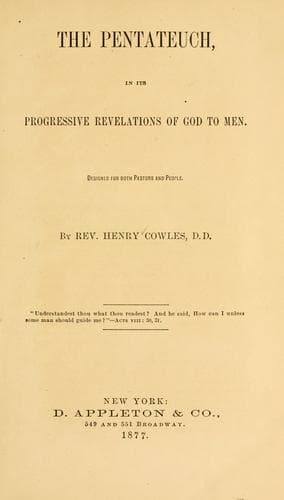
The Pentateuch, in Its Progressive Revelations of God to MenCowles, Henry
Religion
The Pentateuch, in Its Progressive Revelations of God to Men
Cowles, Henry
Bible. Pentateuch -- Criticism, interpretation, etc.
Yet other points might be adduced of coincidence between the sacred and
the profane records of Egypt as the former appear in Moses. The above
may be taken as specimens. Most amply do they testify that the author
of Genesis was entirely familiar with Egyptian life and manners. The
sharpest and most unfriendly criticism has hitherto detected no point
of discrepancy between these respective records――no point in which it
can be made to appear that Moses wrote without well understanding the
Egyptian life of which he speaks.――――The corresponding coincidences in
Exodus will be suggested in their place.
* * * * *
Some special passages occurring in these latter chapters of Genesis
should receive attention.
_Jacob going down into Sheol to his son Joseph._
In Gen. 37: 35 Jacob, supposing Joseph to be dead, says――“I will go
down into the grave (Sheol) to my son mourning.” The reader of the
Hebrew text of Genesis has not met with this word before, and may
reasonably expect to see its meaning discussed here.
In the outset it should be observed that these words can not
possibly mean――My dead body shall go down into the grave proper, the
sepulcher――there to lie by the side of Joseph’s dead body. He could not
have meant this because the place of Joseph’s supposed dead body was
entirely unknown to him. He had seen his bloody coat and inferred that
Joseph was no doubt torn in pieces; _where_, he knew not; and whether
devoured by flesh-eating animals he could not know. We must therefore
reject this construction of his words.――――Plainly the Joseph he thought
of was the undying soul. He expected at his own death to meet Joseph in
that state or place which the Hebrews indicated by the word “Sheol.”
What is the primary significance of this word? What were the views
of the ancient Hebrews in regard to its location and the state of its
occupants?
The noun “Sheol” is made from the verb Shaal[25] having the sense,
to ask, to demand; and conceives of the place as evermore demanding,
insatiable; that which is never full; never has enough. The current
Hebrew conceptions of the word may be seen in Prov. 30: 15, 16, and Isa.
5: 14, and Hab. 2: 5. “There are three things that are never satisfied;
yea four say not, It is enough: the grave” [Sheol], etc.――――“Therefore
hell [Sheol] hath enlarged herself and opened her mouth without measure;
and their glory, and their multitude and their pomp, and he that
rejoiceth shall descend into it.” “Who enlargeth his desire as hell”
[Sheol] “and is as Death, and can not be satisfied,” etc.
Public-domain text, read in full here on John Shaqi.
Reviews
Reviews
No reviews yet
Be the first to share your thoughts on this work.
Elsewhere in the archive
Join the Discussion
Join the discussion
Sign in to leave a comment or review.
Sign InorCreate an account