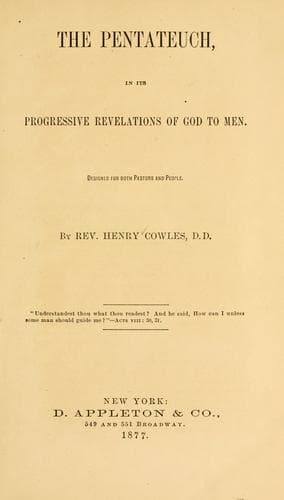
The Pentateuch, in Its Progressive Revelations of God to MenCowles, Henry
Religion
The Pentateuch, in Its Progressive Revelations of God to Men
Cowles, Henry
Bible. Pentateuch -- Criticism, interpretation, etc.
As to the location of Sheol it seems clear that they thought of it as
an _under-world_, as somehow beneath the surface of the earth. We see
this in the case of Korah and his company (Num. 16: 28–34), of whom
Moses said:――“If the earth open her mouth and swallow them up with
all that appertain to them, and they _go down_ alive into Sheol [Eng.
‘the pit’], then shall ye understand that these men have provoked the
Lord” ... “As he had made an end of speaking these words, the ground
clave asunder that was under them and the earth opened her mouth and
swallowed them up,” etc.――――We find the same view in Deut. 32: 22. “For
a fire is kindled in mine anger and shall burn unto the lowest hell
[Sheol], and shall consume the earth with her increase and set on fire
the foundations of the mountains.”
In regard to their conceptions of Sheol as a state of being for the
righteous and the wicked dead, it is easy to see that holy men of
the oldest time lacked the clear light of the gospel age. Then it had
not yet been said――“In my father’s house are many mansions”; “I go
to prepare a place for you, and I will come again and receive you to
myself that where I am, there ye may be also” (Jno. 14: 2, 3). They
had not heard these words of Jesus――“This day shalt thou be with me
in paradise” (Luke 23: 43); those of Paul: “Having a desire to depart
and to be with Christ which is far better” (Phil. 1: 23).――――But
the patriarchs did expect to “be gathered to their people”――the good
men who had gone on before. This is said of Abraham (Gen. 25: 8); of
Ishmael (25: 17); of Isaac (35: 29); and of Jacob (49: 29, 33). David
said of his deceased infant child: “I shall go to him, but he shall not
return to me.” Job said of that little known world――“There the wicked
cease from troubling, and there the weary are at rest” (Job 3: 17),
and yet he sometimes thought of it as intensely dark, for gospel light
had not then fallen upon it:――“Before I go whence I shall not return,
even to a land of darkness and the shadow of death; a land of darkness
as darkness itself; and of the shadow of death without any order, and
where the light is as darkness” (Job 10: 21, 22). Conceptions of this
state as well illustrating the fall and doom of wicked kings and
kingdoms, tinged, it would seem, with the spirit of poetry, may be
seen in Isaiah 14, and Ezek. 31: 15–18.
How far these notions as to the locality of Sheol are to be ascribed
to direct inspiration, and how far to a merely human speculation,
following the leading thought that the body _goes down_ and back to
dust at death, it seems by no means easy to determine positively. We
may be allowed to doubt whether the Lord intended to reveal definitely
the _location_ of human souls after death. It was a point of the
least conceivable importance; and moreover our knowledge of celestial
geography may be yet quite too limited to admit of any intelligible
revelation on this point.
* * * * *
Public-domain text, read in full here on John Shaqi.
Reviews
Reviews
No reviews yet
Be the first to share your thoughts on this work.
Elsewhere in the archive
Join the Discussion
Join the discussion
Sign in to leave a comment or review.
Sign InorCreate an account