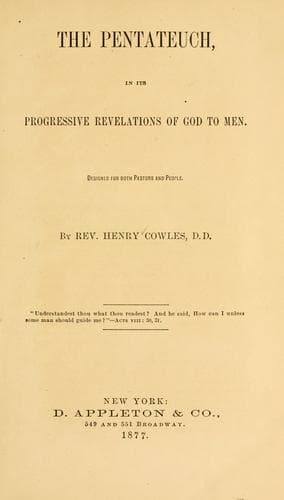
The Pentateuch, in Its Progressive Revelations of God to MenCowles, Henry
Religion
The Pentateuch, in Its Progressive Revelations of God to Men
Cowles, Henry
Bible. Pentateuch -- Criticism, interpretation, etc.
_Jacob’s benedictions upon his sons_ on his death-bed――more or less
prophetic――present some points that call for special notice. Remarkably
they seem in most if not in all cases to start from the then existing
present, and to build their allusions to the future upon it. We see it
in the case of Reuben――noted for his outrage of his father’s nuptial
bed; of Simeon and Levi, whose history suggested their cruelty toward
the men of Shechem; of Judah, whose name bore the thought of _praise_
and whose record in the case of Joseph put him at once in the front
among his brethren; of Joseph, whose relations to his father and indeed
to all the family had been surpassingly precious. The special address
of Jacob to each of these was closely linked to their past history.
The prophetic feature in all these cases seems to have been suggested
by these salient points of their history. Reuben as the first-born
might have kept his supremacy――if he had been worthy of it――but he
was not. Simeon never rose to any distinction, and scarcely held any
well-defined territory in Canaan. Levi came into prominence as the
ancestor of Aaron and of Moses, and redeemed himself also by the
religious zeal and energy of Phineas in a great emergency during the
wilderness life (Num. 26: 6–13). The tribe were scattered in Israel,
yet not in the bad sense. Judah and Joseph had each a future more
resplendent and distinguished than any other of the twelve――their
prominence in Jacob’s benediction being fully carried out through the
history of their nation.
Some special passages and phrases should be briefly explained.
In v. 4, the phrase, “Unstable as water,” does not compare water to the
solid earth or to more solid rock as treacherous to the foot and unsafe
to stand on; but rather as bubbling, effervescing under heat or applied
force――as therefore a fit image of ungoverned passion; of wantonness,
impatient of restraint. Reuben had no moral stamina, and therefore
could not hold his natural place of headship as the first-born――a
moral lesson worthy of thoughtful consideration. A young man given to
licentious indulgence can have no solid bottom to his character. The
sagacious will never trust him.
v. 5. “Simeon and Levi are brethren”――of kindred spirit; “instruments
of cruelty are in their habitation”; better, instruments of cruelty
their swords are. Most solemnly does the dying patriarch disavow
all sympathy with their cruelty!――――The phrase――“Mine honor” in the
sense of myself――my nobler powers――is specially significant here, for
their spirit was dishonorable, treacherous, basely cruel. Jacob had
a sense of honor which utterly forbade all sympathy with them in this
thing.――――In the last clause of v. 6, the English margin gives the
sense of the Hebrew: “They houghed oxen.” They slew not one man only
but man as a species; and cut the hamstrings of their cattle.
* * * * *
Public-domain text, read in full here on John Shaqi.
Reviews
Reviews
No reviews yet
Be the first to share your thoughts on this work.
Elsewhere in the archive
Join the Discussion
Join the discussion
Sign in to leave a comment or review.
Sign InorCreate an account