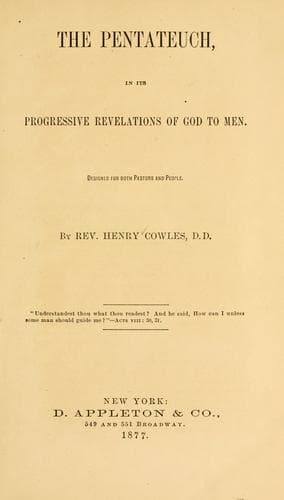
The Pentateuch, in Its Progressive Revelations of God to MenCowles, Henry
Religion
The Pentateuch, in Its Progressive Revelations of God to Men
Cowles, Henry
Bible. Pentateuch -- Criticism, interpretation, etc.
We shall study the history of Moses without _the key_ if we overlook
the point made by the writer to the Hebrews (11: 23): “_By faith_ Moses
when he was born was hid three months because they saw that he was
a proper child, and they were not afraid of the king’s commandment.”
Faith in God made them fearless of Egypt’s cruel king. It would seem
also that they saw in the peculiar beauty of this child a sort of
prophecy of his future, something at least which raised expectation
and put them upon special ventures to save his life. Three months they
secreted him within their home. When this expedient could suffice no
longer, they prepared an ark of bulrushes――a little box, water-tight,
constructed to float――and moored it with its treasure among the flags
on the river’s bank. We may suppose that his mother knew the spot where
the king’s daughter was wont to take her baths, and that her faith and
prayer lay back of this venture to throw her darling infant upon the
compassion of a stranger woman’s heart. It need not be supposed that
she foresaw his future adoption into the royal family, his training
for forty years in all the wisdom of the Egyptians, and his consequent
qualification to become the great Hebrew Lawgiver and Deliverer.
Suffice it that these results lay in the thought of God. She had faith
enough to commit her darling to God’s care and to leave all the future
unknown results to his adjustment.
The ways of God were mercifully kind toward this Hebrew mother. She
stationed his elder sister as a sentinel to watch the issue, and then
(let us presume) gave herself to prayer. When this elder sister with
palpitating heart saw the daughter of Pharaoh take the beautiful child
to her bosom, she felt that her time had come. Modestly advancing, she
said, “Shall I go and call to thee a nurse of the Hebrew women that
she may nurse the child for thee”? Pharaoh’s daughter said, Go. How
joyfully did she go and call the child’s own mother! God’s finger was
there. The mother’s faith has come up as sweet incense before Him and
her heart is made glad, as only a praying mother’s can be. There was
no occasion to tell us that she consecrated this child to Israel’s God
for any service he might have for him in his after life. Such a mother,
drawn by her sweet faith into such relationship to God, could do
nothing less. Moreover, this was no barren consecration――was not a vow
once made and soon forgotten. Nothing can be more certain than that she
cared diligently for the moral training and culture of this marvelously
saved son. Else how could it happen that “when he was come to years,
he refused to be called the son of Pharaoh’s daughter; choosing rather
to suffer affliction with the people of God than to enjoy the pleasures
of sin for a season; esteeming reproach for Christ greater riches than
all the treasures of Egypt, for he had respect to the recompense of the
reward” (Heb. 11: 24–26)? The seeds of this world-conquering faith must
Public-domain text, read in full here on John Shaqi.
Reviews
Reviews
No reviews yet
Be the first to share your thoughts on this work.
Elsewhere in the archive
Join the Discussion
Join the discussion
Sign in to leave a comment or review.
Sign InorCreate an account