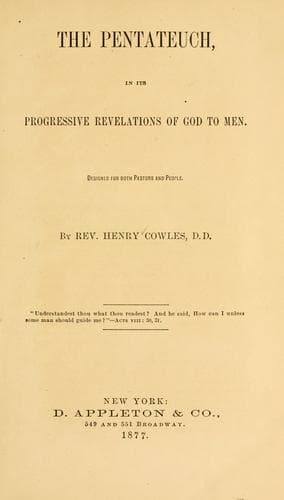
The Pentateuch, in Its Progressive Revelations of God to MenCowles, Henry
Religion
The Pentateuch, in Its Progressive Revelations of God to Men
Cowles, Henry
Bible. Pentateuch -- Criticism, interpretation, etc.
have been dropped early into his tender mind. This hired Hebrew nurse,
permitted to come into the royal palace by some back-way, was indulged
this privilege freely, we know not precisely how long; but let us
presume that the same faith and prayer kept this door open, at least
for her occasional visits in his future years. How many testimonies of
God’s love to the fathers of their nation she dropped into his youthful
ear; how much she told him of God as “the exceeding great reward”
of his believing people; how well she put the contrast between “the
treasures of Egypt” and the treasures laid up for God’s then persecuted
people:――these points are rather left to our inference than definitely
stated; but we may be very sure that the faith of Moses took hold of
these grand truths of then extant revelation; fixed its hold early; and
held fast through all his future life.
We have three co-ordinate narratives of the early years of Moses: that
given in Heb. 11: 24–27, very brief, and touching only its specially
religious side; while that of Stephen (Acts 7: 20–29) is full, even
somewhat more full than the narrative in Ex. 2: 10–15. Particularly
Stephen adds that Moses was “learned in all the wisdom of the Egyptians
and mighty in words and in deeds”――a man like Joseph of immense
efficiency:――also that he was “full forty years old” when it came into
his heart to visit his brethren the children of Israel――a statement
which shows that he distinctly recognized this relationship of brethren.
Seeing a brother Hebrew abused by an Egyptian he interposed, smote
the Egyptian dead, and buried him in the sand. Stephen’s words suggest
that this was not merely one of those quick, spontaneous impulses
felt by noble souls in view of outrageous wrong, but was a first step
toward a contemplated career of interposed force for the rescue of
his people from their oppression. “For he supposed his brethren would
have understood how that God by his hand would deliver them; but they
understood not” (Acts 7: 25). The whole of the fact seems to be that
the Lord was not yet ready and had not fully prepared Moses for this
great life-work of his yet, and certainly had not inaugurated him into
it.[27]――――Interposing the next day in a quarrel between two of his own
Hebrew brethren, he learned that his slaying of the Egyptian was known,
and immediately sought safety by flight to the land of Midian. The Lord
had more objects than one in turning his steps thither; not only his
then present safety, but the spiritual culture of so much solitude and
of long-continued, unbroken communion with God and of long tried faith,
coupled with the incidental advantage of becoming perfectly familiar
with that great wilderness through which he was to lead the hosts of
Israel for forty years.
Public-domain text, read in full here on John Shaqi.
Reviews
Reviews
No reviews yet
Be the first to share your thoughts on this work.
Elsewhere in the archive
Join the Discussion
Join the discussion
Sign in to leave a comment or review.
Sign InorCreate an account