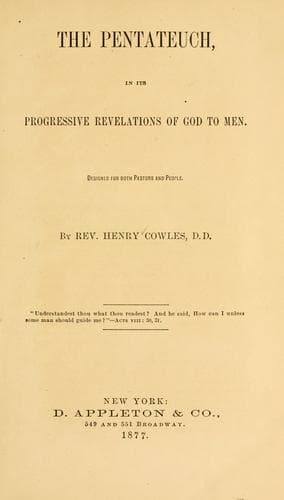
The Pentateuch, in Its Progressive Revelations of God to MenCowles, Henry
Religion
The Pentateuch, in Its Progressive Revelations of God to Men
Cowles, Henry
Bible. Pentateuch -- Criticism, interpretation, etc.
Scarcely had he penetrated this desert land in his flight when he
made the acquaintance of a priest of Midian [Jethro], and of his seven
shepherdess daughters, one of whom became his wife. Like the somewhat
similar experience of Abraham, falling in with the priest of Salem,
♦Melchizedek, the circumstance suggests the inquiry how much of the
true knowledge and worship of God existed in those early ages outside
the line of Abraham’s family. The historical traces of such piety
are certainly very few, yet they recur so incidentally that we are
justified in the hope that these cases are not exhaustive; stood
not altogether alone. When we come to consider the history of Job we
shall take occasion to observe, that his location is certainly in this
great region of Arabia, and that his date must in all probability have
somewhat preceded this residence of Moses in the land of Midian. Here
Moses may have found the story in a traditional form; may perhaps have
seen Job’s immediate descendants; may possibly have put the story in
its present form as one of the pastimes of a literary shepherd’s life;
and then, retaining it in his possession during his subsequent years,
may have himself solved the problem――How came this book in the archives
of the Hebrew nation, on an equal footing as to inspired authority with
their historical books?
_The Great Mission of Moses._
Of the second forty-year period in the life of Moses, little is
reported save its first scenes and its last. Ex. 3 opens the latter.
Moses is keeping the flock of his father-in-law, the priest of Midian.
He has “led them to the back side of the desert”――_i. e._ to the
west side of it, for in designating the points of compass the Hebrews
always turned the face toward the east. The east is in front――_before_;
and of course the west is behind. Horeb and Sinai lay on the western
margin of the great Arabian desert.――――Here “the angel of the Lord
appeared to him” (v. 2), called “angel” however only as one who
comes or is sent with divine manifestations; for in every subsequent
mention he is called “the Lord” and “God” (vs. 4, 6, 7, 11, 13,
etc.)[28]――――Remarkably this visible manifestation was made by the
symbol of fire in a bush――the bush all aflame yet not consumed. This
strange sight attracted the attention of Moses, and he turned aside
to look into it more closely, when a voice from the bush called him
by name; warned him not to approach in the spirit of mere curiosity,
but to take off his shoes because the place on which he stood was holy
ground. The mystery before Moses’ mind is solved――the Lord is there!
His purpose in this appearing is soon told. He has heard the cry of
distress from his oppressed people, has come down to deliver them and
to bring them forth into Canaan. He has a mission for Moses in this
work. “Come” said he, “I will send thee to Pharaoh.” Moses knew the
power and the pride of Pharaoh, and saw at a glance the difficulties
of this enterprise.
Public-domain text, read in full here on John Shaqi.
Reviews
Reviews
No reviews yet
Be the first to share your thoughts on this work.
Elsewhere in the archive
Join the Discussion
Join the discussion
Sign in to leave a comment or review.
Sign InorCreate an account