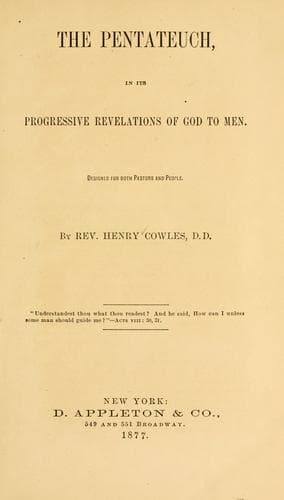
The Pentateuch, in Its Progressive Revelations of God to MenCowles, Henry
Religion
The Pentateuch, in Its Progressive Revelations of God to Men
Cowles, Henry
Bible. Pentateuch -- Criticism, interpretation, etc.
No wonder he shrank back saying――“Who am I that
I should do this”? God replied: “I will certainly be with thee”――a
sufficient answer to any amount of conscious weakness and faintness of
heart. The Lord added――“This shall be a token to thee that I have sent
thee; when thou hast brought the people out of Egypt, ye shall serve
[_i. e._ worship] God in this mountain.” From that moment this token
was God’s pledge to Moses of success in bringing the people forth from
Egypt; and when it was fulfilled in the scenes of national worship and
consecration on Horeb, it became doubly a sign to all the people that
the Lord their God was in this great movement.
Moses anticipates that the people will ask for the name of God, and he
therefore inquires――What shall I answer them? To which the Lord replies:
“_I am that I am_”; and then abbreviating the phrase, adds, “Thus shalt
thou say to Israel, _I am_ hath sent me to you.” What immediately
follows should be carefully noted. God said moreover to Moses (still
reiterating the same thought though in other and more familiar terms):
“Thus shalt thou say to the children of Israel: The Lord――_i. e._
Jehovah, God of your fathers, hath sent me unto you; this is my name
forever and this is my memorial through all generations.” This v. 15
is without doubt the key to the true sense of the names as previously
given――“_I am that I am_,” and in briefer form, “_I am_.” Their
true meaning is in the name _Jehovah_. This name contemplates God
as evermore existing, the same unchangeable God, and therefore ever
faithful to his promises. This view of God assumes that he reveals
himself personally as the God of his trustful people, entering into
covenant with them and never failing to remember and fulfill that
covenant.
In order to see the full force and pertinence of the passage, it should
be considered that by common Hebrew usage, the names of persons were
significant. They were words with a meaning. This is true of all the
names by which the true God is made known. And when Moses suggests that
the people will ask for God’s name, it is not implied that they had
never heard any name for God and did not know what to call him; but
this――They would know what new or special feature of his character was
to be manifested then. Their question was equivalent to asking――What
does God propose to do now? What new movement does he contemplate? What
new development of God may we expect?――――To the question so understood,
the Lord made a direct answer:――I have come to reveal my eternal
faithfulness to my covenant with your fathers. I pledged myself to
Abraham, Isaac and Jacob that I would bring their posterity into the
goodly land of Canaan: I have come down to fulfill that word and to put
into your national history an enduring testimony that my name is truly,
“I am that I am”――the immutable and eternal God, whose word of promise
faileth not forevermore.
Public-domain text, read in full here on John Shaqi.
Reviews
Reviews
No reviews yet
Be the first to share your thoughts on this work.
Elsewhere in the archive
Join the Discussion
Join the discussion
Sign in to leave a comment or review.
Sign InorCreate an account