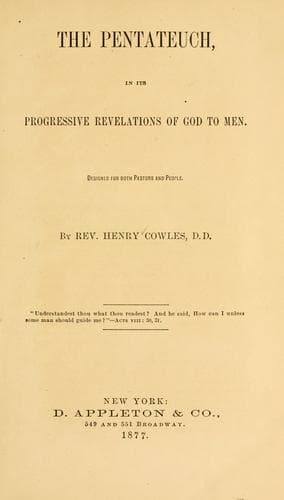
The Pentateuch, in Its Progressive Revelations of God to MenCowles, Henry
Religion
The Pentateuch, in Its Progressive Revelations of God to Men
Cowles, Henry
Bible. Pentateuch -- Criticism, interpretation, etc.
The same course of thought appears again Ex. 6: 1–8――a passage
which should be studied in connection with this. “God said to Moses,
I am the Jehovah. I appeared unto Abraham, unto Isaac, and unto Jacob
by the name of God Almighty; but by my name Jehovah was I not known
unto them”――the meaning of which is, not that the name Jehovah was
never used by them, or given of God to them; but that its special
significance had not been manifested to them as he was then about to
make it manifest. His _power_ God had revealed――his power to protect
them in their perils, his power to fulfill to Abraham the promise of
a son; but such a glorious testimony to his faithfulness in fulfilling
promise as was then to be given, the patriarchs had never seen. The
redemption of Israel from Egyptian bondage was destined to stand
through all the ages of their history as the crowning manifestation
of God’s faithfulness――the standard and unsurpassed testimony to the
significance of his most honored name _Jehovah_. By this shall ye know
that I am Jehovah your God when I bring you out from under the burdens
of the Egyptians and bring you into the land given by solemn oath to
your fathers and to their posterity for a heritage (vs. 7, 8).
* * * * *
In entering upon this redemption of his people the Lord understood well
the difficulties to be overcome and fully comprehended the situation.
If Moses saw them at a glance, so did the Lord also. It was not
possible that Moses could have a deeper sense or a juster view than
God had of Pharaoh’s great pride, of his consciousness of power and
stubbornness of purpose. The Lord expected a conflict; was ready for
it; and by no means disposed to shun it. “I am sure that the king of
Egypt will not let you go; no, not by a mighty hand”――not even under
fearful visitations of God’s supernatural power. The precise sense of
this seems to be that Pharaoh would resist God’s will _for a long time_
despite the inflictions of his mighty hand and would yield only in the
last extremity. In fact he never honestly yielded his will to God’s
will, but only bent for the moment before the blast, to rally again
with more desperate madness after it had swept by. When at length he
saw that the people were really gone, his unsubdued will rose again
in towering hardihood, to rush more madly than ever before against the
uplifted arm of the Almighty and meet his doom in the bottom of the Red
Sea!
Public-domain text, read in full here on John Shaqi.
Reviews
Reviews
No reviews yet
Be the first to share your thoughts on this work.
Elsewhere in the archive
Join the Discussion
Join the discussion
Sign in to leave a comment or review.
Sign InorCreate an account