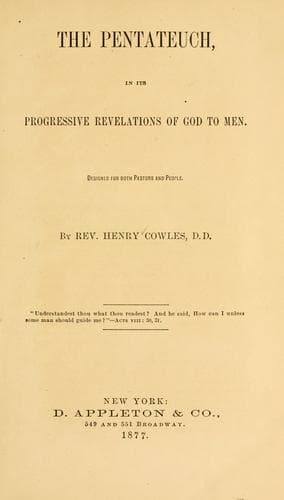
The Pentateuch, in Its Progressive Revelations of God to MenCowles, Henry
Religion
The Pentateuch, in Its Progressive Revelations of God to Men
Cowles, Henry
Bible. Pentateuch -- Criticism, interpretation, etc.
This chapter closes (vs. 21, 22) with directions to the children
of Israel to _ask_ the Egyptians for gold, silver, and raiment.
The Lord promised to give them such favor with the people that they
would readily grant them what they asked. Our English version puts it
“_borrow_”――as if the Israelites at least tacitly promised to bring
these borrowed things back, or if nothing more, left the Egyptians to
expect this. But this English word “borrow” misrepresents the Hebrew
and consequently the sense of the passage. The Hebrew verb used here
never has the sense of _borrow_, but means simply to _ask_. Indeed
borrowing was out of the question because the Israelites were not
coming back again. It was never God’s thought that they should come
back. He had come down to deliver them from their bondage and to bring
them into Canaan. There is no reason to suppose that the Egyptians
expected them back again. They gave what Israel asked, therefore, not
as a loan, but because the Lord brought them into such relations to
Israel that they were glad to get them out of the country any way, and
perhaps hoped to avert more fearful plagues by these gifts to God’s
people. The historian in this case says (Ex. 12: 33)――“The Egyptians
were urgent upon the people that they might send them out of the
land in haste; for they said――We be all dead men”; which the Psalmist
confirms (Ps. 105: 38)――“Egypt was glad when they departed, for the
fear of them fell upon them.” Manifestly the Lord counted it simple
justice that Egypt should pay her slaves for long years of unrequited
toil, and not send them away empty. Therefore he took measures to make
the old masters but too glad to do this tardy justice.
* * * * *
A new instrumentality of most vital importance now came to view,
designed to bring about the redemption of God’s people from Egypt,
viz. _supernatural agencies――miracles_ in the legitimate sense of the
word. Noticeably these miracles were two-fold in character and purpose;
one class designed to identify God to the people and be a witness to
his present hand, to confirm their faith in him as their Deliverer:
the other designed by terrible inflictions of calamity, to force upon
Pharaoh’s hardened heart the conviction of Jehovah’s power and compel
him to let God’s people go. These two objects were to be accomplished;
the Hebrew people were to be assured that their own God had indeed come;
Pharaoh must be made to know who Jehovah is; how fearful the judgments
of his uplifted hand are; and how vain it is for mortals, though on
thrones of human power, to lift up themselves against the Almighty.
In the list of miraculous signs sent to convince the Hebrew people, we
have (Ex. 4: 1–8) the rod of Moses turned to a serpent and then turned
back again to a rod; then his hand withdrawn from his bosom leprous,
white as snow; then again withdrawn, perfectly restored.
Public-domain text, read in full here on John Shaqi.
Reviews
Reviews
No reviews yet
Be the first to share your thoughts on this work.
Elsewhere in the archive
Join the Discussion
Join the discussion
Sign in to leave a comment or review.
Sign InorCreate an account