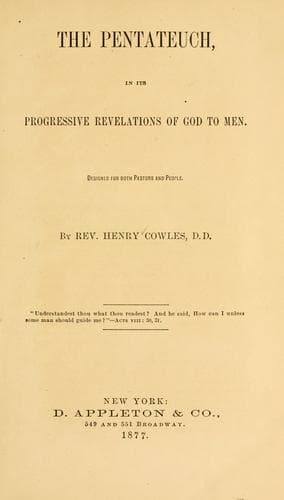
The Pentateuch, in Its Progressive Revelations of God to MenCowles, Henry
Religion
The Pentateuch, in Its Progressive Revelations of God to Men
Cowles, Henry
Bible. Pentateuch -- Criticism, interpretation, etc.
The narrative gives the reader a strong sense of the reluctance of
Moses to enter upon this new mission. Over and over again, in varying
forms, he pleads his want of adaptation; that he is slow of speech,
not eloquent; that he sees no improvement in this regard since the Lord
first spake to him; and finally he begs the Lord to send by any body
else he pleases, only (he implies) excuse me. Plainly he pushed this
plea for excuse not merely to the verge of modest propriety but beyond
it, for we read――“The anger of the Lord was kindled against Moses.”
Yet he did so far regard the plea of Moses as to give him Aaron his
elder brother to speak in his behalf. “Thou shalt speak to him and put
words into his mouth; he shall be thy spokesman to the people,” and to
Pharaoh.
The way is now prepared for Moses and his family to return from
Midian to Egypt. He took his wife and his two sons and proceeded on
his journey. The scenes of the first night at the inn are recorded in
these words: “And it came to pass by the way in the inn, that the LORD
met him, and sought to kill him. Then Zipporah took a sharp stone, and
cut off the foreskin of her son, and cast _it_ at his feet, and said,
Surely a bloody husband _art_ thou to me. So he let him go: then she
said, A bloody husband _thou art_, because of the circumcision.” This
account is very brief, leaving various points unexplained. Probably
the facts were substantially these. Of their two sons, one had been
circumcised; the other had not――the prescribed rite having been
disobeyed or at least neglected out of the deference of Moses to the
opposition or reluctance of his wife. But as Moses is now about to
assume the highest responsibilities between God and the Hebrew people,
it is vital that his example in this respect should be spotless.
The Lord therefore called him suddenly to account in this manner,
threatening his very life. The cause is instantly understood; the wife
of Moses yields and herself performs the rite, though perhaps not in
the most submissive and amiable spirit. After this transaction and the
developments attending it, we must suppose that Moses (prudently) sent
back his wife and the two children to remain with her father until the
redeemed Israelites should reach the home of Jethro. We hear no more of
her and her children till the narrative in Ex. 18 brings them to view
thus: “When Jethro had heard all that the Lord had done for Moses and
Israel, he took Zipporah, Moses’ wife, _after he had sent her back_,
and her two sons and brought them to Moses” etc.――――Shortly after this
scene at the inn, Aaron, sent of God for this purpose, meets Moses
yet in the wilderness and is introduced to his responsibilities in
the issues then pending before Pharaoh and the people. Their first
introduction to Pharaoh and the reception he gave to their message
(Ex. 5) revealed his character and gave pre-intimations of the conflict.
They put their case before him:――“Thus saith the Lord God of Israel,
Public-domain text, read in full here on John Shaqi.
Reviews
Reviews
No reviews yet
Be the first to share your thoughts on this work.
Elsewhere in the archive
Join the Discussion
Join the discussion
Sign in to leave a comment or review.
Sign InorCreate an account