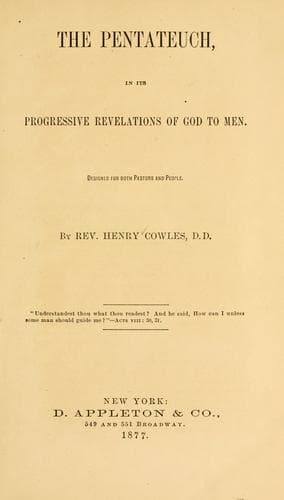
The Pentateuch, in Its Progressive Revelations of God to MenCowles, Henry
Religion
The Pentateuch, in Its Progressive Revelations of God to Men
Cowles, Henry
Bible. Pentateuch -- Criticism, interpretation, etc.
This point would scarcely need special definition had not extreme views
been put forth in our times; as (_e. g._) that nature is virtually
a second-rate deity――indebted to God, indeed, for the original gift
of its powers, but thenceforward working those powers independently
of God――made to run without God after he has once wound it up as the
mechanic makes and winds up his watch. But the Scriptures recognize no
such semi-deification of nature. According to their teaching, God still
“_upholds_ all things by the word of his power” (Heb. 1: 3); “By him
all things consist” (Col. 1: 17)――_i. e._, are maintained in their
existence――are held to system and order under natural law. It is
precisely God himself who gives or withholds the rain; who calls to
the lightnings and they answer, “Here we are”――(Job 38: 35); and it
is none the less God who wields these agencies because he does it in
harmony with principles which are just as fixed as he pleases to have
them. Therefore true science will take no exception to the doctrine
that nature is nothing more or less than _God’s established mode of
operation_. We may call these modes of operations “laws” or “powers,”
and may think and speak of them as constituting “Nature;” but if we
come to regard Nature as a maker and a doer, working independently of
God, we have (inadvertently perhaps, but none the less really) ruled
God out of his own universe. Both Scripture and reason hold that “in
him we live and move and have our being.” (Acts 17: 28.) The broad fact
that God’s intelligent creatures must live in this material world and
be constantly acting upon matter and acted upon by matter, suggests
abundant reasons why God should ordain fixed laws for the changes and
states of all material things. But why should we think of God’s hand as
any the less present in all these changes of material states and forms
because they follow fixed and ascertainable laws? In truth the divine
wisdom is only the more abundantly manifested by means of this reliable
uniformity.
Another doctrine yet more extreme severs all connection between
nature and an intelligent Power above and over her, and thus makes
her _supreme_ in her domain. This is so far Atheism――ruling God out
from at least the entire material universe.――――Yet, again; to make
nature herself intelligent――to ascribe to nature whatever traces of
design appear in her operations, and to hold that nature is herself
the universe, undistinguishable from any higher spiritual power, is
Pantheism.――――It is therefore important to define nature so that her
true relations to the Supreme Intelligence――the very God――Creator
and Lord of the universe――shall be distinctly seen and reverently
recognized.
Public-domain text, read in full here on John Shaqi.
Reviews
Reviews
No reviews yet
Be the first to share your thoughts on this work.
Join the Discussion
Join the discussion
Sign in to leave a comment or review.
Sign InorCreate an account