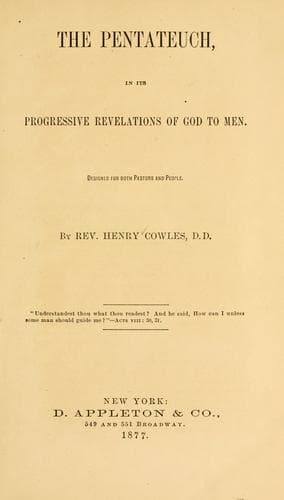
The Pentateuch, in Its Progressive Revelations of God to MenCowles, Henry
Religion
The Pentateuch, in Its Progressive Revelations of God to Men
Cowles, Henry
Bible. Pentateuch -- Criticism, interpretation, etc.
The plague of locusts brings to view a new group of elements. Egypt
had known something about locusts before: so when this scourge was
announced, Pharaoh’s servants beg him to yield the contest. “How
long shall this man” [Moses] “be a snare unto us? Let the men go that
they may serve the Lord their God. Knowest thou not yet that Egypt is
destroyed”? (10: 7).――――Pharaoh yields to their entreaty only so far as
to send for Moses and Aaron, and again try his hand upon bantering with
them and with God over the conditions. “Go serve the Lord, said he; but
_who are they that shall go_”? Moses answers, Every thing must go; we
with our young and with our old; with sons and with daughters; with
flocks and with herds――all, absolutely _all_ must go.――――No indeed,
replies Pharaoh――with what we must take as his royal oath――with the
most fearful threat he could make and the most solemn asseveration――he
says, “_Not so_; go _ye that are men_ and serve the Lord, for that ye
did desire.” That was all ye asked at first: it is the utmost I shall
give! “And they were driven out of his presence.” Pharaoh is thoroughly
mad! This allowing himself to banter them as to the terms of the
arrangement helped him to a stronger feeling of his own importance. He
seemed to himself to be yet more a king on his throne, and why should
not he dictate the conditions?――――Soon the plague comes, and for the
moment it quite changes the face of affairs. “Pharaoh called for Moses
and Aaron in haste, and said” [again]――“I have sinned against the Lord
your God and against you. Now, therefore, forgive, I pray thee, my sin
only this once, and entreat the Lord your God that he may take away
from me this death only.” Apparently he remembers that once before
he confessed, and more than once has begged their prayers, and more
than once has promised to let the people go. So he labors to give
a little more emphasis to his beseechings this time by confessing
his sin against Moses, and especially by the limitation――“_for this
once_”――once more _do_ hear me――this time only. But he has been through
this very process once before; most of its points, many times before;
and it is much more easy for him to turn back upon every promise and
break every most solemn vow than it ever has been before. It is safe to
predict that any sinner who has broken so many solemn vows of amendment
will never do any thing better than break vows when God’s mercy lifts
off the plague. So Pharaoh’s heart is hardened yet again. The statement
is――“But the Lord hardened Pharaoh’s heart”――yet the way he did it,
here as before (9: 34), was by removing the plague; by hearing his
prayer for relief and apparently trusting his sacred promise to let
the people go. This was the way and these the agencies by which the
Lord hardened Pharaoh’s heart.
Public-domain text, read in full here on John Shaqi.
Reviews
Reviews
No reviews yet
Be the first to share your thoughts on this work.
Elsewhere in the archive
Join the Discussion
Join the discussion
Sign in to leave a comment or review.
Sign InorCreate an account