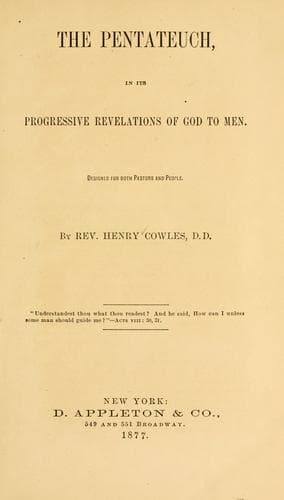
The Pentateuch, in Its Progressive Revelations of God to MenCowles, Henry
Religion
The Pentateuch, in Its Progressive Revelations of God to Men
Cowles, Henry
Bible. Pentateuch -- Criticism, interpretation, etc.
The plague of darkness is next in order. Again Pharaoh sets himself to
negotiate as to the terms. He will consent that not only the men may go,
but their wives and their little ones; _but their flocks must be left
behind_. He must have some hostages――something left in his hands that
will bring his bondmen back. Moses says _No!_ we need our flocks for
sacrifice; not a hoof is to be left behind! Pharaoh is more mad than
ever: he not only drives Moses out from his presence, but adds――“Take
heed to thyself; see my face no more; for in the day thou seest my face
thou shalt die.” In this case it is said――“The Lord hardened Pharaoh’s
heart”; but these terrible uprisings and outbursts of madness well up
from the depths of a depraved sinner’s soul. No supernatural miracle
of divine hardening is at all needful to create them. Pharaoh is too
proud a king to bear such confrontings of his will. Shall he yield to
such a man as Moses, or even to the God of Moses? Not he. It stirs up
all the elements of his pride and madness to have his propositions of
compromise so peremptorily rejected. It is this in special that works
in this present case to the hardening of his heart.
There remains but one more plague――that awful night on Egypt when the
wailing cry rang out over all the land, “for there was not a house
where there was not one dead”! and that the _first-born_! Under this,
Pharaoh for the time really broke down; he called for Moses and Aaron
by night and said――“Go ye and all your people, and take your flocks
and herds as ye have said and be gone, and bless me also.” This
conceded everything, closing off with begging their blessing upon his
consciously guilty soul! The Egyptians too were all astir; they were
urgent upon the people to send them out of the land in haste; for
they said――“We be all dead men.” And the people of Israel do really
go.――――But strange as it may seem, when “it was told the king of Egypt
that the people had really gone, then the heart of Pharaoh and of his
servants was turned against the people and they said――Why have we done
this that we have let Israel go from serving us”?――――Forthwith armed
chariots are made ready and are off in hot pursuit;――till they find
themselves battling the mighty waves of the Red Sea, quailing before
the awful eye and under the uplifted arm of the Almighty!――――This
last instance of hardening the heart seems most like pure and simple
infatuation. No doubt Pharaoh and his servants had a fresh sense of
what they had lost in letting go such a host of hard working bondmen.
No doubt they also felt the mortification of having been worsted in
the long-fought struggle over this national question of letting the
people go; but after all they had seen and felt of God’s power to
curse and to plague and to crush them, nothing but the most senseless
infatuation can rationally account for this last desperate dash upon
Israel with the armed force of the nation. Yet no one will say that
Public-domain text, read in full here on John Shaqi.
Reviews
Reviews
No reviews yet
Be the first to share your thoughts on this work.
Elsewhere in the archive
Join the Discussion
Join the discussion
Sign in to leave a comment or review.
Sign InorCreate an account