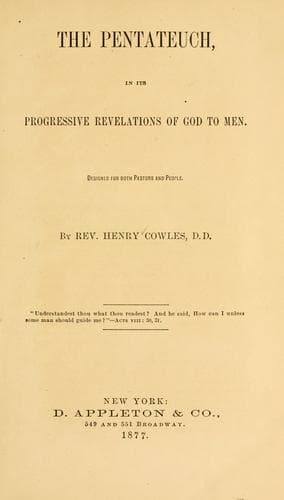
The Pentateuch, in Its Progressive Revelations of God to MenCowles, Henry
Religion
The Pentateuch, in Its Progressive Revelations of God to Men
Cowles, Henry
Bible. Pentateuch -- Criticism, interpretation, etc.
such infatuation does not often appear in the history of human sinning.
In his own sphere many a poor sinner is just as madly infatuated as
Pharaoh and his people were――is altogether as senseless, as void of
wisdom, as reckless of the hot thunderbolts of the Almighty! It is an
awfully sad fact, a most humiliating confession as to the manner of
human sinning; but it is only too true! There is no need of assuming
any direct supernatural divine interposition to produce it.
Nothing more seems necessary to complete the argument from the history
of the case unless it be to suggest that when we have accounted for the
hardening of Pharaoh’s heart satisfactorily on the one principle――the
well-known proclivities and activities of a proud, stubborn human heart,
it is entirely unphilosophical to bring in another principle, viz. the
miraculous, immediate, direct action of Almighty Power. When we have
proved the former power adequate to produce all the results, we have
virtually precluded the latter. There can be no reason whatever for
assuming a joint, co-ordinate action of both the natural laws of the
human mind and of the supernatural power of God. If the former suffices,
the latter is uncalled for. Miracles are never to be assumed where
non-miraculous agency is fully adequate.
If it be still argued that the very words declare, “God hardened
Pharaoh’s heart,” the answer is: God is said to do what he foresees
will be done by others and done under such arrangements of his
providence as make it possible and morally certain that they will do
it. Joseph said to his brethren (Gen. 45: 5, 7, 8), “Be not angry with
yourselves that ye sold me hither, for God did send me before you to
preserve life. So now it was not you that sent me hither but God.”
Yet it is simply impious to put the sin of selling Joseph into Egypt
over upon God. God did it only in the same sense in which he hardened
Pharaoh’s heart. He had a purpose to subserve by means of the sin of
Joseph’s brethren; and he did no doubt permit such circumstances to
occur in his providence as made that sin possible and as resulted in
their sinning and in the remote consequences which God anticipated.
It is of no particular use for us to find fault with the way in which
the Scriptures speak of God’s hand in the existence of sin. There is no
special mystery about it. It certainly does not involve the least moral
obliquity on God’s part; and it is therefore every way prudent and wise
to interpret such language in harmony with the common sense of the case
and with the well-known character of God.
* * * * *
Public-domain text, read in full here on John Shaqi.
Reviews
Reviews
No reviews yet
Be the first to share your thoughts on this work.
Elsewhere in the archive
Join the Discussion
Join the discussion
Sign in to leave a comment or review.
Sign InorCreate an account