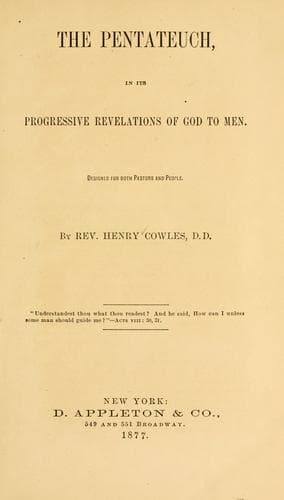
The Pentateuch, in Its Progressive Revelations of God to MenCowles, Henry
Religion
The Pentateuch, in Its Progressive Revelations of God to Men
Cowles, Henry
Bible. Pentateuch -- Criticism, interpretation, etc.
2. We proceed to notice what is said of _God’s purpose_ in the
hardening of Pharaoh’s heart. It is the more important to speak of this
because an extreme view is sometimes taken of the central passage (Ex.
9: 14–16); “And in very deed for this cause have I raised thee up for
to show in thee my power,” etc. The extreme view referred to is that
God made Pharaoh a great king, put him on a high throne, for the avowed
purpose of displaying his own great power in his sin and punishment.
By consent of Hebrew lexicographers, the verb translated “_raised
up_” means in this case _preserved alive_――have _caused thee to stand_
or continue among the living. The previous context moreover seems not
to be quite accurately put in our English version. It should rather
be thus, beginning with v. 14: “For at this very time I am sending
[present tense] all my plagues to thine heart and upon thy servants and
upon thy people that thou mayest know that there is none like me in
all the earth. For I might now have stretched out my hand and smitten
thee and thy people with pestilence [_i. e._ might have smitten you all
dead], and thou wouldest have been cut off from the earth. But truly
for this very reason have I preserved thee alive to the end that thou
mightest show forth [make others see] my power, and for the sake of
proclaiming my name in all the earth.” To the same purport are the
words (Ex. 14: 17, 18) with reference to the final destruction of
Pharaoh’s host; “And I will get me honor upon Pharaoh and upon all
his host, etc. And the Egyptians shall know that I am the Lord when I
shall have gotten me honor upon Pharaoh and upon his chariots and his
horsemen.” The great thought is that God turns to account the sin and
madness of Pharaoh for the purpose of making known his power to save
his people and to crush their foes. He shapes his ways of providence to
this end. He might have swept off Pharaoh and his people with the same
pestilence which destroyed so many of their cattle; but he had a wiser
purpose. He could make a better use of their sin and of their life; so
he spared them till he had wrought all his wonders upon Egypt before
all the nations of the earth; and then he let them plunge into the
mighty waves of the Red Sea and make their grave there!――――Now if
wicked men _will sin_, who shall object against God that he makes the
best possible use of it? Why may he not reveal his power thereby and
exalt his name as one “mighty to save” or to destroy?
3. It only remains to ask――What has God taught us of his character as
bearing on the question before us, and of his agencies in the existence
of sin?
Public-domain text, read in full here on John Shaqi.
Reviews
Reviews
No reviews yet
Be the first to share your thoughts on this work.
Elsewhere in the archive
Join the Discussion
Join the discussion
Sign in to leave a comment or review.
Sign InorCreate an account