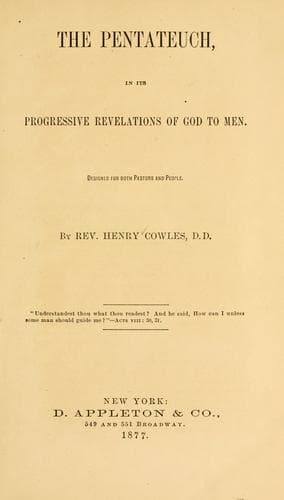
The Pentateuch, in Its Progressive Revelations of God to MenCowles, Henry
Religion
The Pentateuch, in Its Progressive Revelations of God to Men
Cowles, Henry
Bible. Pentateuch -- Criticism, interpretation, etc.
Here few words ought to suffice. Nothing can be more plain than the
revelations of scripture concerning God’s character as infinitely pure
and holy――as a Being who not only can never sin himself but can never
be pleased to have others sin, and above all can never put forth his
power to _make them sin_. God can not be tempted with evil, “_neither
tempteth he any man_” (Jam. 1: 13). When he declares so solemnly and
so tenderly: “O do not that abominable thing which I hate”! shall it
still be said――But he puts men to sinning; pushes them on in their
sin; inclines their heart to sin and hardens them to more and guiltier
sinning? Never!
Shall it be claimed that with one hand God gives his Spirit to impress
the truth on human souls unto their salvation; and with the other sends
his Spirit to augment the forces of temptation and to harden men’s
hearts unto their damnation? Shall the same fountain send forth both
sweet water and bitter? Shall the same God renew some human hearts unto
holiness and harden other human hearts in sin――all by the same direct
and similarly purposed agency, each work being done under the same
impulses of infinite love?――――Surely there must be some egregious
misconception of God’s character involved in supposing him capable
of acts so fundamentally opposite and incompatible――not to say, in
supposing him capable of tempting men into more and greater sin!
The fact that He wisely and mightily over-rules sin to bring good forth
from it should never be construed to imply that he abhors sin any the
less because he can extort some good results from its existence.
CHAPTER XIII.
THE PASSOVER.
THE first of the three great annual festivals of Israel, and the one
which above all was commemorative in character――a memorial service――was
the _Passover_. It was designed to commemorate the deliverance of
Israel from Egyptian bondage――the great birth-hour of the Hebrew nation.
Especially did it commemorate the scenes of that last eventful night
when God caused his angel of death to _pass over_ the houses of Israel
as he went through the land of Egypt, smiting the first-born in all her
households.――――The central thing in this institution was the slaying
of the paschal lamb――one for each household――and the sprinkling of
its blood upon the two side-posts, and upon the lintel over the door
of each house. This sprinkled blood, seen by the destroying angel,
became his authority for _passing over_ and by that house, sparing its
first-born, while he spared not one first-born of all the families of
Egypt.
There were numerous collateral points in the institution, designed to
fill it out more completely and make it most impressively a memorial
service for all the future generations of Israel; _e. g._ the following:
Public-domain text, read in full here on John Shaqi.
Reviews
Reviews
No reviews yet
Be the first to share your thoughts on this work.
Elsewhere in the archive
Join the Discussion
Join the discussion
Sign in to leave a comment or review.
Sign InorCreate an account