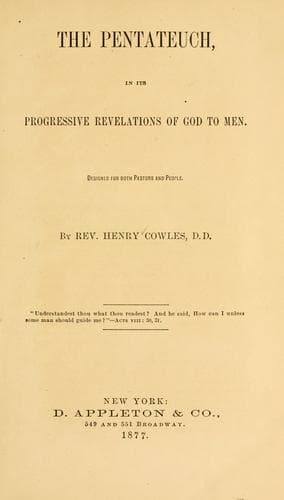
The Pentateuch, in Its Progressive Revelations of God to MenCowles, Henry
Religion
The Pentateuch, in Its Progressive Revelations of God to Men
Cowles, Henry
Bible. Pentateuch -- Criticism, interpretation, etc.
As to _time_; it was on the fourteenth day of the month Abib,
corresponding to our March or April――the night next following this
day being that of the last plague on Egypt――the night which broke
their yoke of bondage. Henceforth, this was made the first month in
the Hebrew year.
The paschal lambs were _taken by households_. If the family was large,
it stood by itself; if too small to consume one lamb, then two or more
were united, the aim being to have the flesh of the lamb eaten entire.
If any thing remained, it was to be burned in the morning.――It was to
be roasted with fire, not eaten raw, and not boiled in water. (Ex. 12:
8, 9.) The arrangement _by families_ looked toward the great fact of
the original event――that Egypt was _smitten by families_――there being
not a house in which there was not one dead. Its influence must have
been precious through all the ages of Hebrew history in cementing
family ties and sanctifying the family relation.
It was eaten with _unleavened bread_――the rule on this point being most
stringent. No leaven might be eaten or even seen in their households
during the entire feast of seven days. So prominent was this fact that
the feast was called interchangeably, “The Passover,” or “The feast of
unleavened bread.”――――The original design of this prohibition seems to
have been commemorative――the great haste of their departure precluding
the preparation of leavened bread for their journey. The allusions
to “leaven” in the New Testament (Matt. 16: 6, 11, 12, and Luke 12
and 1 Cor. 5: 7) indicate that leaven was associated with “pride that
puffeth up,” and is quite the opposite of that simplicity and purity
of heart which God loves.
It was also eaten with bitter herbs, the vegetable condiments of the
supper suggesting the bitterness of that bondage in Egypt out of which
they came (Ex. 12: 8).――――Yet another suggestive memorial usage was to
eat with loins girt, shoes on, staff in hand (Ex. 12: 11), and in haste,
as men ready to start a journey at a moment’s warning.
The feast continued seven days (Ex. 12: 14–20), beginning with
the evening of the paschal supper. The first day and the last were
specially sacred, all labor being prohibited except that which was
necessary in preparing their food (Ex. 12: 16).――――The object in
allowing so much time was to provide for extended religious ceremonial
services and for wholesome social communion, not to say also for
cultivating national sympathy and patriotism. As all the males from
every tribe in the whole land were required to come together on this
great feast to the one place which God should appoint, the convocation
was vast, and its social and religious influences were naturally both
wholesome and great.
Public-domain text, read in full here on John Shaqi.
Reviews
Reviews
No reviews yet
Be the first to share your thoughts on this work.
Elsewhere in the archive
Join the Discussion
Join the discussion
Sign in to leave a comment or review.
Sign InorCreate an account