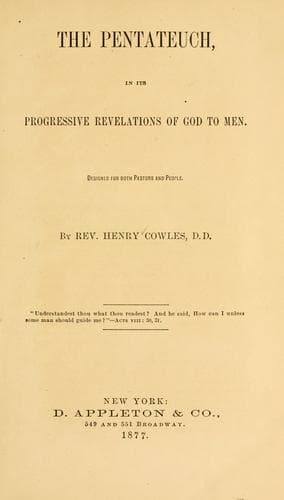
The Pentateuch, in Its Progressive Revelations of God to MenCowles, Henry
Religion
The Pentateuch, in Its Progressive Revelations of God to Men
Cowles, Henry
Bible. Pentateuch -- Criticism, interpretation, etc.
How long the pot of manna was preserved in the ark of the covenant
can not be known definitely. We have the fact that the Lord directed
its preservation there (Ex. 16: 32–34); and the further fact that
when the ark was placed in the new temple of Solomon there was nothing
in it save the two tables of stone (1 Kings 8: 9). It was doubtless
kept long enough to subserve all the valuable purposes of a memorial
to the generations of Israel. It has been embalmed in the Christian
consciousness of the Christian age by its symbolical use in the
teachings of our Lord in which it represents his flesh which he gave
for the life of the world――the far more real bread of life from heaven
(John 6: 31–35, 47–58).
_Water Supplied by Miracle._
The subsistence of the Israelites during forty years in the desert of
Arabia involved not only a supply of bread but of _water_ also. On two
distinct occasions――the first at Rephidim, close to Horeb, during the
last half of the second month from Egypt; and the second at Kadesh, in
the northern border of the great desert, and during the first month of
the fortieth year from Egypt,[38] water was supplied them by miracle.
So great a multitude of people, including their animals, must have
required a large supply of water. Nothing therefore is more probable
than that the supply should often be short, and sometimes utterly fail.
At Rephidim the people most unreasonably chode with Moses as if he
alone was responsible for bringing them out of Egypt and for the lack
of water, and as if their sufferings were so great as altogether to
eclipse all the blessings of that great deliverance. Moses had no help
but in the Lord his God. In answer to prayer the Lord provided for a
miracle, to be well attested by the presence of a body of the elders of
the people. “Take them with thee,” saith the Lord, “and take also thy
rod wherewith thou smitest the river” (the Nile) “and go. I will stand
before thee there upon the rock in Horeb and thou shalt smite the rock,
and there shall come water out of it that the people may drink.”――――The
names given were significant――“Massah” of their _tempting_ the Lord by
their unbelief; Meribah, of their _chiding_ and _strife_ as to Moses.
Public-domain text, read in full here on John Shaqi.
Reviews
Reviews
No reviews yet
Be the first to share your thoughts on this work.
Elsewhere in the archive
Join the Discussion
Join the discussion
Sign in to leave a comment or review.
Sign InorCreate an account