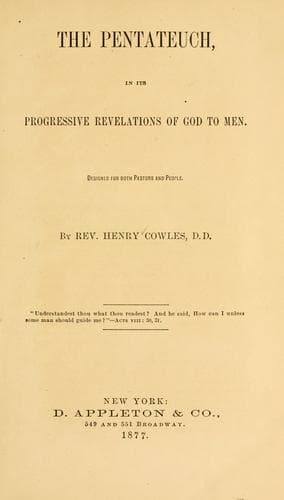
The Pentateuch, in Its Progressive Revelations of God to MenCowles, Henry
Religion
The Pentateuch, in Its Progressive Revelations of God to Men
Cowles, Henry
Bible. Pentateuch -- Criticism, interpretation, etc.
The scenes at Kadesh (Num. 20) were almost forty years subsequent, and
consequently involved another generation. The spirit of their complaint
was quite the same however――chiding Moses most unreasonably, petulantly
wishing they had died before the Lord as so many of their brethren
who had fallen under God’s judgments in the wilderness since the
unbelieving report of the spies and the consequent wrath of God upon
the people. Sadly we must note here that this unreasonable and even
cruel reflection upon Moses stirred his indignation, excited him unduly,
and found expression in ill-advised words from his lips. The Lord
had told him to take Aaron his brother, to gather the people together
before the rock, and then _speak_ to the rock before their eyes and
it should give forth water. When the eventful moment came, Moses,
instead of saying――Ye have sinned against the Lord your God, yet in
his mercy he will give you rivers of water from this rock upon the
word of command from his servant――said as in the record――“Hear now, ye
rebels, must _we_ fetch you water out of this rock”? In circumstances
where man should be nothing and God all in all――man only a consciously
unworthy instrument, and God the Supreme and ever to be honored Power,
it was one of the sad infirmities of the best of men to put himself
so prominently forward and thrust the Great God so ungratefully into
the back-ground. Then, moved by the same excited passion, instead of
speaking to the rock, he smote it with his rod, not once only but twice.
Yet the Lord did not rebuke him with failure, but despite of his bad
spirit, gave forth water abundantly. The rebuke upon both Moses and
Aaron came shortly after in the form of an absolute prohibition upon
their entering the land of promise. They had _so_ dishonored the Lord
in this case at Kadesh that he must needs express his disapprobation
by denying to both of them the long-desired consummation of entering
the goodly land.――――If the Lord’s rebuke of Moses seem severe, let it
be considered that his sin was very great because he had been admitted
into so near communion with God――such communion as had never been
granted to any other man. If the guilt of sin be as the light sinned
against, we are not likely to overestimate the guilt of his. The Lord
speaks of it as rebellion (Num. 27: 14). And manifestly his sin was
so public as well as so flagrant that it became vital to the honor of
God’s name and government to rebuke it unmistakably.
The exclusion from Canaan fell sorely upon the heart of Moses. He
prayed earnestly that God would reverse this decree, but in vain. The
Lord shut off all hope, saying, “Let it suffice thee; speak no more
unto me of this matter” (Deut. 3: 23–27). Sorrowful are the words of
Moses: “I must die in this land; I must not go over Jordan” (Deut.
4: 21).
Public-domain text, read in full here on John Shaqi.
Reviews
Reviews
No reviews yet
Be the first to share your thoughts on this work.
Elsewhere in the archive
Join the Discussion
Join the discussion
Sign in to leave a comment or review.
Sign InorCreate an account