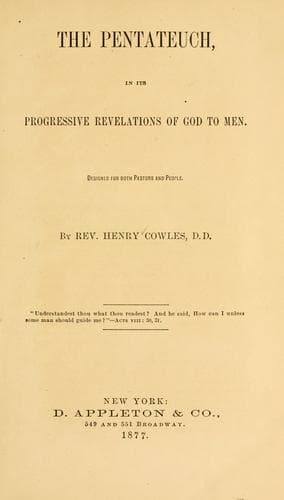
The Pentateuch, in Its Progressive Revelations of God to Men — John Shaqi
The Pentateuch, in Its Progressive Revelations of God to MenCowles, Henry
Religion
The Pentateuch, in Its Progressive Revelations of God to Men
Cowles, Henry
Bible. Pentateuch -- Criticism, interpretation, etc.
To set aside this testimony from usage as being inapplicable to the
present case, it has been said――(a.) That here is a succession of days,
“first day,” “second day,” “third day,” etc., and that this requires
the usual sense of days of the week.――――To which the answer is that
here are six special periods succeeding each other――a sufficient
reason for using the word in the peculiar sense of a period of special
character. Each of these periods is distinct from any and all the rest
in the character of the work wrought in it.――――The reason for dividing
the creative work into six periods――“days”――rather than into more or
fewer lies in the divine wisdom as to the best proportion of days of
man’s labor to the one day of his rest, the Sabbath. God’s plan for
his creative work contemplated his own example as suggestive of man’s
Sabbath and was shaped accordingly. This accounts for dividing the work
of creation into six special periods, correlated to God’s day of rest
from creative work.――――(b.) It will also be urged that each of these
days is said to be made up of evening and of morning――“The evening
and the morning were the first day,” etc. But the strength of this
objection comes mainly from mistranslation and consequent misconception
of the original. The precise thought is not that evening and morning
composed or made up one full day; but rather this: There was evening
and there was morning――day one, _i. e._, day number one. There was
darkness and then there was light, indicating one of the great creative
periods.[3]
It is one thing to say――There were alternations of evening and
morning――_i. e._ dark scenes and bright scenes――marking the successive
periods of creation, first, second, third, etc.; and another thing to
affirm that each of these evenings and mornings _made up_ a day. The
point specially affirmed in the two cases, though somewhat analogous,
is not by any means identical.――――Let it be considered moreover, that
while in Hebrew as in English, _night_ and _day_ are often used for the
average twelve-hour duration of darkness and of light respectively in
each twenty-four hours, yet in neither language are the words _evening_
and _morning_ used in this sense, as synonymous with night and day.
Indeed “evening” and “morning” are rather points than periods of time;
certainly do not indicate any definite amount of time――any precise
number of hours; but are used to denote the two great changes――_i. e._
from light to darkness and from darkness to light; in other words,
from day to night and from night to day. Therefore to make evening and
morning added together constitute one day is entirely without warrant
in either Hebrew or English usage and can not be the meaning of these
passages in Genesis.[4]
(2.) _The showing of the narrative itself_, considered apart from the
bearing of geological facts.
Public-domain text, read in full here on John Shaqi.
Reviews
Reviews
No reviews yet
Be the first to share your thoughts on this work.
Join the Discussion
Join the discussion
Sign in to leave a comment or review.
Sign InorCreate an account