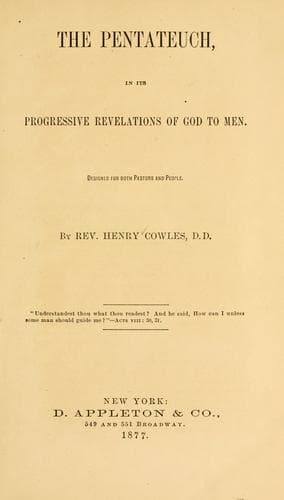
The Pentateuch, in Its Progressive Revelations of God to Men — John Shaqi
The Pentateuch, in Its Progressive Revelations of God to MenCowles, Henry
Religion
The Pentateuch, in Its Progressive Revelations of God to Men
Cowles, Henry
Bible. Pentateuch -- Criticism, interpretation, etc.
(a.) Here vs. 3–5 demand special attention, this first day being the
model one.――――I understand “evening” to be the chaotic state of v. 2,
when “darkness was on the face of the deep,” and “morning” to be that
first “light” which God spake into being. The reason for using these
words――“evening and morning”――in this sense I find in the universal
sentiment of mankind that light is pleasant and darkness is not. This
sentiment is indicated here; “God saw the light that it was good.” The
state of chaos was in contrast with this――dismal, dreary, awakening no
sense of beauty or order; no emotions of joy. The light of day brings
joy, and the freshest and best sensation of it comes with the morning.
Hence these words were fitly and beautifully appropriate to the two
great creative states――first chaos; secondly, light――which together
marked off the first of the six creative days.――――But we can not for
a moment think of this chaotic state as being only twelve hours. We
can not rationally think of the word “evening” applied to it as having
any reference to time, duration. It was an evening only in the sense
of being dark, desolate, any thing but joyous like the morning. The
word “evening” may be chosen rather than night for the sake of a more
perfect antithesis with “morning.”
(b.) Throughout at least the first three of these creative epochs
there was no sun-rising and setting to mark off the ordinary day.
These therefore were not the common human day; but, as Augustine long
ago said, these are the days of God――divine days――measuring off his
great creative periods. God moved through these six great periods by
successive stages of labor and of rest. Beginning with the long evening
of chaos; then advancing to a glorious day of light; then, after a
cessation analogous to man’s rest by night, he proceeded to the work of
the second day――the joyous and beautiful development of the firmament
in the heavens. So onward by stages of repose and of activity, these
figurative evenings and mornings continued through the six successive
epochs of creation.
Public-domain text, read in full here on John Shaqi.
Reviews
Reviews
No reviews yet
Be the first to share your thoughts on this work.
Join the Discussion
Join the discussion
Sign in to leave a comment or review.
Sign InorCreate an account