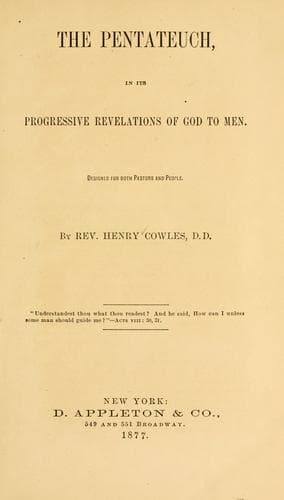
The Pentateuch, in Its Progressive Revelations of God to MenCowles, Henry
Religion
The Pentateuch, in Its Progressive Revelations of God to Men
Cowles, Henry
Bible. Pentateuch -- Criticism, interpretation, etc.
The written description of this scene
gives us a sense of its ineffable grandeur and sublimity. “Mount Sinai
was altogether on a smoke because the Lord descended upon it in fire;
and the smoke thereof ascended as the smoke of a furnace, and the whole
mount quaked greatly. When the voice of the trumpet sounded long and
waxed louder and louder, Moses spake and the God answered him by a
voice.”――――Essentially the same descriptive points are repeated after
the record of the law as promulged from Sinai (Ex. 20: 18–21). “All
the people saw the thunderings and the lightnings and the noise of
the trumpet and the mountain smoking; and when the people saw it, they
removed and stood afar off, and said to Moses: Speak thou with us and
we will hear; but let not God speak with us lest we die.” See also the
renewed mention of this scene in Deut. 4: 10–12.[39]
_The Moral Law as given from Sinai._
Passing from the natural surroundings and scenes of Sinai to
the law itself, let it be observed carefully that this law of ten
commandments (Ex. 20: 1–17 and Deut. 5: 6–21) is to be somewhat broadly
distinguished from the other “statutes and judgments,” whether civil
or religious, which the Lord gave to Israel by the hand of Moses;――this
distinction being apparent in the following points and for the reasons
which they suggest:
1. It was proclaimed by God himself in a most public and solemn manner
in the hearing not of Moses alone, but of the elders of the people at
least, if not of the people en masse, assembled before and around the
glorious mount.
2. It was given under circumstances of most appalling majesty and
sublimity――the mountain being enveloped with clouds and thick darkness,
yet at some moments all ablaze with the lightning’s flash and rocking
beneath Jehovah’s feet.
3. It was written by the finger of God on two tables of stone (Deut.
5: 22).
4. It differed from any and all other laws given to Israel in that it
was comprehensive and general rather than specific and particular.
5. It was complete, being one finished whole to which nothing was to be
added――from which nothing was ever taken away. (“And he added no more”
Deut. 5: 22. See also Mat. 5: 18). The other statutes, as we shall see,
were subjected to future modification.
6. The law of the ten commandments was honored by Jesus Christ as
embodying the substance of the law of God enjoined upon man. With
a master’s hand he grasped and brought out its two great principles,
underlying all the precepts: Love supreme to God: love equal and
unselfish toward fellow-men. “Thou shalt love the Lord with all thy
heart, and thy neighbor as thyself.” (Mat. 22: 36–40, and 19: 18, 19
and Mk. 12: 28–34).
7. It can scarcely be doubted that Jesus had his eye specially
if not exclusively on this law (Mat. 5: 18) as _one never to be
repealed_――from which not one jot or tittle should ever pass away.
Public-domain text, read in full here on John Shaqi.
Reviews
Reviews
No reviews yet
Be the first to share your thoughts on this work.
Elsewhere in the archive
Join the Discussion
Join the discussion
Sign in to leave a comment or review.
Sign InorCreate an account