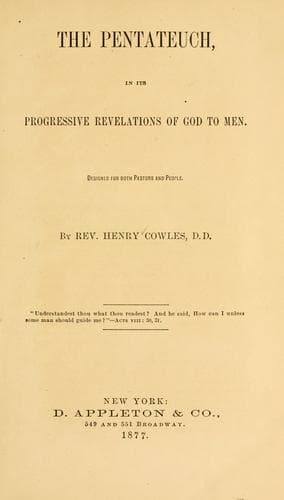
The Pentateuch, in Its Progressive Revelations of God to MenCowles, Henry
Religion
The Pentateuch, in Its Progressive Revelations of God to Men
Cowles, Henry
Bible. Pentateuch -- Criticism, interpretation, etc.
To this great moral law of ten commandments we now give special
attention and note――That its introduction (Ex. 20: 2), “I am the Lord
thy God which have brought thee out of the land of Egypt――out of the
house of bondage”――is special――not general and universal; is adapted
to the circumstances of Israel, and gives a special reason why _they_
should honor this law as coming from the God of their national covenant,
the Redeemer and Savior of their nation. On the one hand this special
reason why Israel should render supreme homage to Jehovah as their
Deliverer from Egyptian bondage neither applies specifically to all
mankind, nor does it imply that this law is not binding on other people
than Israel. It was pertinent that as given originally to them it
should be preceded and introduced by this special consideration, so
pertinent to their case. Yet it should be thoughtfully considered――God
might have said most truly to every child of his great human family――I
am He who gave thee thy being and every good; and therefore I claim
thy supreme love and homage.――――I see no reason to question that this
clause was put on the two tables of stone――its special introduction as
given to the children of Israel.
I. In the first precept, the words “before me” are construed variously.
The most usual and obvious translation of the Hebrew words is――_before
my face_. In some connections the preposition might mean _upon_ or
_above_. “My face” is thought by some to be merely equivalent to
_myself_. Keil translates――“literally _beyond me_, or in addition
to me, equivalent to except me, or by the side of me.” He rejects
the construction, “before me” (in my presence) as incorrect, and
also condemns _against me_――in opposition to me. Fuerst has it “above
_i. e._ except me.” Murphy says――“before me” is literally “upon my
face.” It supposes those other gods to be set up _before_ the true
God as antagonists in the eye of God and as casting a shade over his
eternal being and incommunicable glory in the eye of worshipers.――――The
two constructions――_beyond_ me and _above_ me――are open to the
objection that they seem tacitly to admit other gods provided they
are inferior and that God is supreme. I prefer as the more obvious and
natural construction――_before my face_. Thus the precept forbids homage
to any other god in the presence of the supreme and omniscient Jehovah;
and by consequence, forbids divine honor to any other being or thing
whatsoever. “Thou shalt have no other gods _before my face_” seems
to imply that the least acknowledgment of other gods is in its very
nature an insult to Jehovah, as if it thrust those gods into his
very face――held them up before his eye as more worthy of homage than
he. Moreover, as no possible worship of other gods can escape his
eye, or be otherwise than thrust up before his face, the prohibition
necessarily shuts off all such worship. You may never worship other
gods than the One Supreme Being, for it is simply impossible that any
Public-domain text, read in full here on John Shaqi.
Reviews
Reviews
No reviews yet
Be the first to share your thoughts on this work.
Elsewhere in the archive
Join the Discussion
Join the discussion
Sign in to leave a comment or review.
Sign InorCreate an account