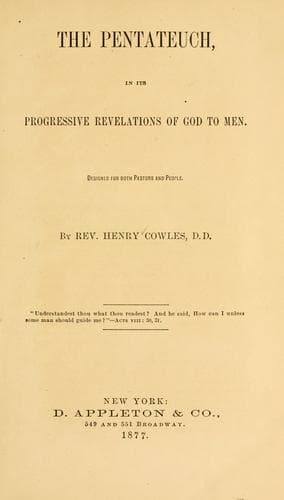
The Pentateuch, in Its Progressive Revelations of God to MenCowles, Henry
Religion
The Pentateuch, in Its Progressive Revelations of God to Men
Cowles, Henry
Bible. Pentateuch -- Criticism, interpretation, etc.
such worship can elude his eye, and you must not put it before his face.
II. The second command prohibits the making and worshiping of images
designed to represent idol gods――imaginary powers, supposed to have
more or less control over human welfare. It equally prohibits images
designed to represent the true God. All such sensuous conceptions of
God are necessarily debasing. They rest on false views of God; tend
to fearful and fatal degeneracy; and must therefore be forbidden under
most stringent penalties. The whole history of our race witnesses to
the infinite mischief wrought by such sensuous conceptions of God, as
well as by the notion of subordinate powers, lower than the one supreme
yet more than human. This has been one of Satan’s devices to rule God
out of his universe and transfer to other objects the worship due to
God alone.
This prohibition as it stands here is not enforced by specific
penalties, but in a way far more impressive it bears us back to the
very heart of God, revealing his holy _jealousy_ of any rival to his
throne who would wrest and steal away from him the supreme love and
homage of his creatures, and give it to supposed gods that are no Gods
at all. “For I am a jealous God, visiting the iniquity of the fathers
upon the children unto the third and fourth generation of them that
hate me.”――――By the very law of the family relation, the great sins
of the father send their curse down upon his children. He makes them
heirs to an inheritance of shame and sorrow. He entails calamity upon
his offspring. Godless and idolatrous himself, he makes his family also
godless and idolatrous. The influence of his sin will naturally and
almost inevitably blight the morals and the souls of his children after
him, and of his children’s children. Let this fact throw its shield
like a wall of fire around him and his family, so that, if not for his
own sake, at least for the sake of his unborn offspring, he will most
sacredly obey this command and abstain from the least infringement of
it in spirit or in letter.
Public-domain text, read in full here on John Shaqi.
Reviews
Reviews
No reviews yet
Be the first to share your thoughts on this work.
Elsewhere in the archive
Join the Discussion
Join the discussion
Sign in to leave a comment or review.
Sign InorCreate an account