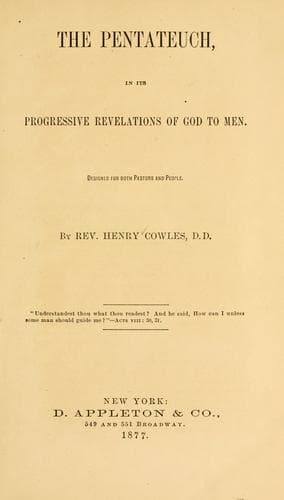
The Pentateuch, in Its Progressive Revelations of God to MenCowles, Henry
Religion
The Pentateuch, in Its Progressive Revelations of God to Men
Cowles, Henry
Bible. Pentateuch -- Criticism, interpretation, etc.
“Visiting iniquity” and “showing mercy” are set over against each
other――the penal visitations of judgment for this sin warning men
against it; and the great promises of mercy to the obedient alluring
them to its most diligent observance. Judgment is God’s strange
work, while mercy is his delight. Therefore we have here the forceful
antithesis――the visiting of the iniquities of fathers upon children
to the third and fourth generation, but the showing of mercy unto
thousands of generations of them that love and obey. To a Hebrew mind
this last clause of the second command would naturally suggest God’s
mercies to Abraham, the well-known friend of God, upon whose posterity
God was shedding forth his blessings to thousands of generations. So
richly does the loving God reward his dutiful and trustful children! So
much more grateful to his heart it is to bless even to the thousandth
generation than to visit iniquity even so far as to the third and
fourth!
It should be carefully noted that the visiting of the iniquities of
fathers upon sons falls only _upon those who hate him_. If sons in
any future generation turn from their sinning to the love of God,
his merciful loving-kindness to them is sure. The curse visits only
those who persist in the sin of their fathers despite of all the
warning judgments that should admonish them to fear God. (See Ezek.
18).――――This injunction against image-making and worship would
naturally suggest to the men of Israel the idolatrous Egyptians. Their
early fathers received from Noah the knowledge of the one only true
God. But they did not love this knowledge, nor the God whom it revealed;
therefore, not liking to retain these views of the pure and holy God,
they chose to think of him as being like some of his works and began to
worship such imaginary gods; or they put in his place some lower beings
or powers as objects of worship. Hence the terrible judgments which the
children of Israel had seen falling upon Egypt and her idols.
“Upon those that love me” is delightfully suggestive of the great
truth that the essence of all acceptable worship is love. God looks
complacently on his human children when they delight in his glory, love
his character, rejoice in his blessedness, and make it the best joy of
their souls to please him by doing all his will. Such love legitimately
flows out in reverent worship and adoring homage. Over against this the
worship of idols in place of God is congenial only to the souls that
hate God. This command assumes that those who worship other gods really
hate the one Supreme Jehovah. Therefore it is that his jealousy burns
against them. They withhold from him the love and the homage of their
hearts.
Public-domain text, read in full here on John Shaqi.
Reviews
Reviews
No reviews yet
Be the first to share your thoughts on this work.
Elsewhere in the archive
Join the Discussion
Join the discussion
Sign in to leave a comment or review.
Sign InorCreate an account