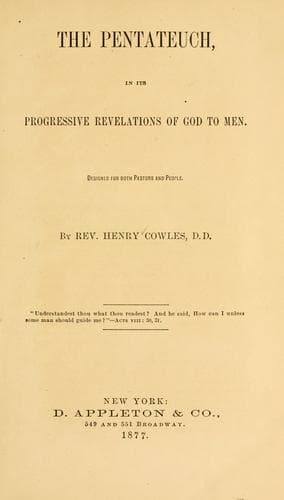
The Pentateuch, in Its Progressive Revelations of God to MenCowles, Henry
Religion
The Pentateuch, in Its Progressive Revelations of God to Men
Cowles, Henry
Bible. Pentateuch -- Criticism, interpretation, etc.
Let us not omit to notice that it was this precept which opened the
spiritual eye of Paul and gave him a new view of the breadth and true
significance of God’s law. “I had not known sin, (said he) but by the
law; for I had not known lust except the law had said, Thou shalt not
covet” (Rom. 7: 7). His Pharisaic training (we may suppose) had been
scrupulous over the tenth part of the mint and anise and cummin――had
taken even ostentatious care of the external matters of the law;
but, alas! had _left the heart out_. Here at the close of the
law of Sinai――last among the precepts that treat of duty to our
neighbor――stands one which puts its finger squarely upon the _heart_.
It says――“Thou shalt not _covet_.” It not only suggests that God
looks within the soul of man for sin, but it demands that every man
shall look there too and put his own restraining hand directly upon
those rising desires which, indulged, would push him into overt sin.
Moreover, this one precept may be supposed to have suggested to the
mind of Paul that the whole law of God must be construed on this
heart-principle――that every precept it contains goes beyond the letter
to the spirit――pushes its demand deeper than the outward act, even to
the inner thought, passion, and purpose of the soul. This view put the
law of God in a new light――we might even say――revealed a new law to his
soul. It gave him a new field for self-examination; brought up new sins
never seen or dreamed of before, and at once demolished hopes of favor
before God and of salvation on which he had perilously leaned through
all his Pharisaic life.――――“Thy commandment” (said one of the Psalmists)
“is exceeding broad” (Ps. 119: 96). We are not to think of all the Old
Testament saints as Pharisees. Let us rather hope that many of them
read in the law of Sinai the law of love, and adjusted to it, not the
outward life only but the very heart as well.
_Progress in the Revelation of God to Man._
The first twenty chapters of Exodus cover a period eminently rich in
point of _progress_ in revealing God to the race.――――More fully than
ever before God manifested those special elements of his character
which are unfolded in the new name Jehovah――I am that I Am (Ex. 3: 14).
He had given promises before; then he came forth to _fulfill_ them. He
had talked with the patriarchs about faith, and had sought to inspire
it in their souls. In these great deeds for his people he gave them
demonstrations of his eternal faithfulness――a basis on which their
faith might rest, and also the faith of every child of his through all
the future ages. God came exceedingly near to his afflicted people in
Egypt, and never missed any opportunity of suggesting and impressing
the idea that these tender testimonies of his love were in proof of
his _fidelity to promise_――were the very acts which his covenant with
Abraham involved and called for――called for of their covenant God not
in vain.
Public-domain text, read in full here on John Shaqi.
Reviews
Reviews
No reviews yet
Be the first to share your thoughts on this work.
Elsewhere in the archive
Join the Discussion
Join the discussion
Sign in to leave a comment or review.
Sign InorCreate an account