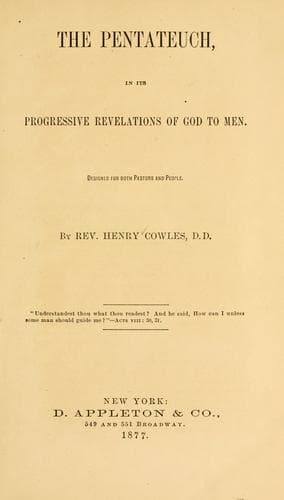
The Pentateuch, in Its Progressive Revelations of God to MenCowles, Henry
Religion
The Pentateuch, in Its Progressive Revelations of God to Men
Cowles, Henry
Bible. Pentateuch -- Criticism, interpretation, etc.
of the ancient usages of the patriarchal system. The latter is the true
view, for the patriarchal system had the prestige of common law; and
we find not the least hint of any _election_ of these “heads of the
house of their fathers” for any special function――no notice of their
receiving special instructions to act as delegated representatives
of the people.――――Let it be noted carefully that on all really great
occasions when the vital issues of their covenant relation with God
were pending, “all the people”――the solid masses――were convened, and
of course their elders and high officers with them. We see such a case
before Sinai (Ex. 19); another, shortly before the death of Moses, in
a solemn ratification of their national covenant: “Ye stand this day
_all of you_ before the Lord your God; your captains of your tribes,
your elders and your officers, with all the men of Israel” (Deut. 29:
10–12), “that thou shouldest enter into covenant with the Lord thy God,”
etc.――――Again; after they had entered Canaan in the scene of rehearsing
the blessings and the curses of the law from Mt. Gerizim and Mt. Ebal:
“And all Israel and their elders and officers and their judges, stood,”
etc. (Josh. 8: 33). See also Josh. 23: 2 and 24: 1 and Judg. 20: 1 and
1 Sam. 8. It was supremely appropriate that every man of Israel should
give his voice and heart in these great national consecrations of
themselves to their nation’s God. The Lord sought to call into action
every mind――to make a deep moral impression on every heart. Therefore
none could be exempted; no man could be excused for absence.
IV. The scope afforded under this system
for _self-government――democracy_.
It is readily obvious that under this theocracy, the function of
_legislators_ was out of the question. The people did not make their
own laws: these were _given_ them――made by the Lord alone. It only
remained for them to say whether they would accept the Lord their God
as their Lawgiver and Supreme King. Such assent and consent on their
part was appropriate; and precisely this they gave――as we may see in
the case of the moral law of Sinai (Ex. 19: 3–8 and Deut. 5: 27, 28);
and of all the statutes and judgments of their civil code (Ex. 24: 3).
This national recognition of God as Supreme Lawgiver was renewed from
time to time with subsequent generations of Israel (Deut. 29: 10–15 and
Josh. 24: 15–27 and Neh. 10: 28, 29), etc.
Thus it appears that the laws under which they lived were not
arbitrarily imposed upon them without their consent――much less, against
their will; but only with their formal and solemn consent. So far forth,
their government involved an element of freedom and of self-control.
They were not tyrannously coerced into subjection to laws which they
repudiated. A system of law, in itself most excellent and entirely
unexceptionable, was presented to them for their adoption or rejection.
They adopted it――apparently with the warmest approbation.
Public-domain text, read in full here on John Shaqi.
Reviews
Reviews
No reviews yet
Be the first to share your thoughts on this work.
Elsewhere in the archive
Join the Discussion
Join the discussion
Sign in to leave a comment or review.
Sign InorCreate an account