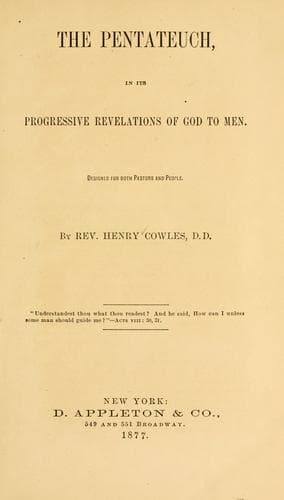
The Pentateuch, in Its Progressive Revelations of God to MenCowles, Henry
Religion
The Pentateuch, in Its Progressive Revelations of God to Men
Cowles, Henry
Bible. Pentateuch -- Criticism, interpretation, etc.
Essentially the same principle obtained in regard to their highest
human executive officer. They did not nominate and choose Moses of
their own motion. No caucus, no primary meeting, no formal election
brought out his name as the choice of the people. The Lord alone raised
up Moses, prepared him for the position he was to hold and brought him
before the people. Then they received him as their leader (Ex. 4: 29–31
and 20: 19 and Deut. 5: 27). In the same manner they accepted Joshua
(Josh. 1: 16–18). In the case of Saul, their first king, the Lord
nominated, and the people ratified his nomination (1 Sam. 10: 24
and 11: 14, 15). The Lord called David also (1 Sam. 16: 1–12), but
the people accepted him as king and cordially ratified his divine
nomination (2 Sam. 5: 1–3). Through his prophet Nathan the Lord gave
the kingdom to David’s posterity (2 Sam. 7) and prophetically indicated
Solomon (1 Chron. 22: 8, 9 and 1 Kings 1: 13, 29, 30); but the people
still gave their full-hearted consent (1 Kings 1: 39, 40). The same
powers were asserted by the people in the case of Rehoboam (1 Kings
12: 1–20).
It should be specially noted that when the government assumed the form
of a _human_ monarchy――an earthly king reigning under God in this real
theocracy, it was a limited, not an absolute monarchy. The Mosaic law
anticipated this change and imposed certain constitutional limitations
upon the prospective king (Deut. 17: 14–20). He must be one whom the
Lord should choose; of native and not foreign birth; must not multiply
horses, nor wives, nor treasures of silver and gold; must keep by him
a copy of the law given through Moses, must read it and regard it as
the constitution under which he reigned. When the demand for a king
arose Samuel forewarned the people of the assumptions of power which,
by the usages of mankind, they must expect in their king (1 Sam. 8:
10–17), and took the precaution to put in writing “the manner of the
kingdom”――the constitutional provisions and safe-guards under which
he was to reign (1 Sam. 10: 25). No copy of this constitution has
come down to us; but it doubtless corresponded essentially with the
limitations made by the law of Moses as in Deut. 17: 14–20.
Public-domain text, read in full here on John Shaqi.
Reviews
Reviews
No reviews yet
Be the first to share your thoughts on this work.
Elsewhere in the archive
Join the Discussion
Join the discussion
Sign in to leave a comment or review.
Sign InorCreate an account