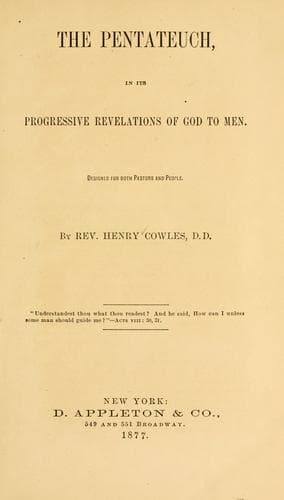
The Pentateuch, in Its Progressive Revelations of God to MenCowles, Henry
Religion
The Pentateuch, in Its Progressive Revelations of God to Men
Cowles, Henry
Bible. Pentateuch -- Criticism, interpretation, etc.
The voice of the people in self-government appears also in the
appointment of the judges who were to administer the law in courts
of justice. We have seen how the old patriarchal system was enlarged
and modified at the suggestion of Jethro (Ex. 18: 13–26). This first
narrative seems to rest the appointment of these judges entirely
with Moses; but his own more detailed account (Deut. 1: 9–18) shows
that the people were heard in the nomination: “Take you wise men and
understanding, and known among your tribes, and I will make them rulers
over you. And ye answered me and said――The thing which thou hast spoken
is good for us to do. So I took the chief men of your tribes, wise men
and known, and made them heads over you,” etc. Plainly these men had
acquired position by merit, and held their place and power (before
this special appointment) by the general consent of the people.――――The
general law in the case runs――“Judges and officers shalt thou make
thee in all thy gates, etc., and they shall judge the people with just
judgment” (Deut. 16: 18).
Self-government is further developed in the independent action which we
may notice occasionally in the several tribes. Especially in the period
from Joshua to Saul, the several tribes acted singly, or in union with
one or more of their fellow-tribes at their option (Judg. 1: 1–3, 22
and 4: 10 and 7: 23, 24 and 8: 23, and 20: 11–46). Special cases of
this independent action appear in 1 Chron. 4: 41–43 and 5: 18–23.――――On
great occasions, the people convened en masse for deliberation and
united action as in Josh. 22: 12, 16 and 23: 2 and Judg. 20 and
21.――――Obviously they assumed the right to disapprove the action of
their princes as in the case of the Gibeonites (Josh. 9: 18, 19)――“All
the congregation murmured against the princes.”
V. _The Fundamental Principles of this entire System._
1. Jehovah being their Supreme King, supreme love and worship must be
rendered to him.
2. Idolatry was a state offense, nothing less than high treason, and
therefore a capital crime, punishable with death. Any one of their
cities, given to idolatry, must be utterly exterminated (Deut. 13: 1–18
and 17: 2–7).
3. The most stringent laws ordained non-intercourse with idolatrous
nations and non-conformity to their customs. Inter-marriages with them
were strictly prohibited; trade and commerce were at least discouraged
if not forbidden. These laws may be seen in Ex. 34: 11–17 and Deut.
7: 1–5, 16, 23–26; and cases of their application in Num. 25 and 31;
also in Ezra 9 and 10 and Neh. 13: 23–31.
Sundry customs, some of which might in themselves be of small account,
were prohibited, apparently because associated with idolatry in the
usages of other nations and in the ideas of the people of Israel
(Deut. 14: 1–21 and Lev. 20: 23– 26). The distinction between clean
and unclean beasts seems to fall under this principle.
Public-domain text, read in full here on John Shaqi.
Reviews
Reviews
No reviews yet
Be the first to share your thoughts on this work.
Elsewhere in the archive
Join the Discussion
Join the discussion
Sign in to leave a comment or review.
Sign InorCreate an account