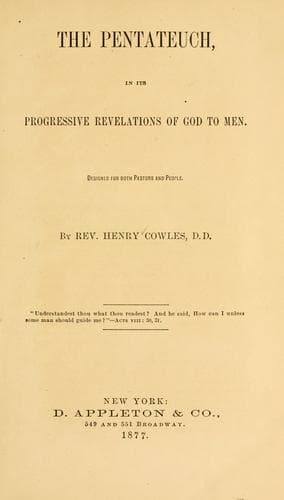
The Pentateuch, in Its Progressive Revelations of God to MenCowles, Henry
Religion
The Pentateuch, in Its Progressive Revelations of God to Men
Cowles, Henry
Bible. Pentateuch -- Criticism, interpretation, etc.
4. This Hebrew Theocracy was engrafted upon a previously existing
patriarchal government, and therefore it recognized this previous
system as substantially the common law of the land, to be in force
except so far as modified by special legislation under the new regime
given from the Lord through Moses. This principle is illustrated in
the powers and functions of the _elders_, known as “heads of the house
of their fathers”; “princes”; “heads of the thousands of Israel” (Ex.
6: 25, and Num. 3: 24, 30, 35, and 1: 16, and 10: 4).
5. It was manifestly an accepted principle, underlying the entire
system, to give the people as wide a range of free responsible action
as a theocratic government would admit. Democracy must of necessity be
subordinate to _theocracy_; the self-ruling of the people must find its
place _under_ the supreme ruling of Jehovah. Consequently the law must
come entire from God, not from the people. The chief executive must
receive his commission from God, though he might be formally accepted
and his appointment in this way ratified by the people. The Lord sought
the willing homage of the people――the obedience of their heart――and
therefore encouraged the most cheerful and hearty expression of their
will and of their homage in entering into covenant with himself, and
from time to time in solemnly renewing it. He would have them feel that
they were the people of the Lord by their own real consent and hearty
acceptance. So much democracy therefore entered into their scheme of
national polity. So much there might be. In the nature of a theocracy,
there could not be more.
6. As elsewhere shown, the statutes were within certain limits
graduated in moral tone to the moral status of the people, being as
high as they would bear――as near theoretical perfection as could be
made effective――_i. e._ as could secure a general obedience.
VI. _Its union of Church and State._
By this modern phrase is currently meant the subordination of the
church to the civil or state authorities. Such a union in the Hebrew
nation was a natural consequent upon a theocratic government. The civil
code coming from God himself, the religious code must come from him by
obvious fitness, not to say necessity. In his entire policy with Israel,
God sought the most effective moral culture. We find this purpose
underlying the entire civil government with its code of civil laws; it
must of course underlie their religious institutions. Hence the church
and the state were worked not only by the same hand but for the same
general purpose.
Public-domain text, read in full here on John Shaqi.
Reviews
Reviews
No reviews yet
Be the first to share your thoughts on this work.
Elsewhere in the archive
Join the Discussion
Join the discussion
Sign in to leave a comment or review.
Sign InorCreate an account