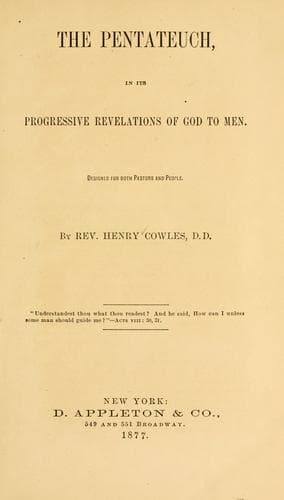
The Pentateuch, in Its Progressive Revelations of God to MenCowles, Henry
Religion
The Pentateuch, in Its Progressive Revelations of God to Men
Cowles, Henry
Bible. Pentateuch -- Criticism, interpretation, etc.
These labors of the sixth day, moreover, were precisely
such as should not be rushed through in haste. The importance, not to
say solemnity, of these transactions and the special interest they must
be supposed to awaken in the first-born “sons of God” most stringently
preclude precipitate haste. It is not easy to see how Moses or his
intelligent readers of the early time could have supposed all this to
have transpired within the twelve hours of light in a human day.――――We
may say, moreover, in regard to each and all of these six creative
periods that if the holy angels were indeed spectators of these scenes
and if God adjusted his methods of creation to the capacities of these
pupils――these admiring students of his glorious works――then surely
we must not think of his compressing them within the period of six
human days. Divine days they certainly must have been, sufficiently
protracted to afford finite minds scope for intelligent study, adoring
contemplation, and as the Bible indicates, most rapturous shouts of joy.
Against the theory of indefinitely long periods, it is objected that
_the law of the Sabbath demands the usual sense of the word “day.”_
The record in Gen. 2: 2, 3, is――“On the seventh day God ended his work
which he had made; and he rested on the seventh day from all his work
which he had made. And God blessed the seventh day and sanctified it,
because that in it he had rested from all his work which he had created
and made.” The words of the fourth command are――“Six days shalt thou
labor and do all thy work; but the seventh day is the Sabbath of the
Lord thy God, etc.――for in six days the Lord made heaven and earth:
wherefore the Lord blessed the Sabbath day and hallowed it.”――――The
real argument here rests on the analogy between God’s working and
resting, and man’s labor and rest. In each case the period of labor
is six out of seven; of rest, one in seven. This argument does not
require that God’s six working days and one resting day should be of
twenty-four hours each. If it did, we should be hard pressed to show
that God’s seventh day of rest from creation’s work was a merely human
day from sun to sun. No; it suffices if we make God’s days of creative
energy and of creative rest each and all _divine days_――all alike
periods of indefinite length――all of the same sort; and on the other
hand man’s days of labor and his day of rest, all human days, of the
same sort with each other, from sun to sun. As God’s resting day is
plainly of indefinite length――a period known by its character and not
by its duration, so should his days of creative labor be: not only
so _may_ they be, but so they _ought_ to be according to the analogy
and argument in the case.――――We come therefore to the conclusion that
entirely apart from the demands of geological science, the creative
days must be periods of indefinite length, called “days” with reference
to the peculiar work done in them and to their peculiar character, and
Public-domain text, read in full here on John Shaqi.
Reviews
Reviews
No reviews yet
Be the first to share your thoughts on this work.
Join the Discussion
Join the discussion
Sign in to leave a comment or review.
Sign InorCreate an account