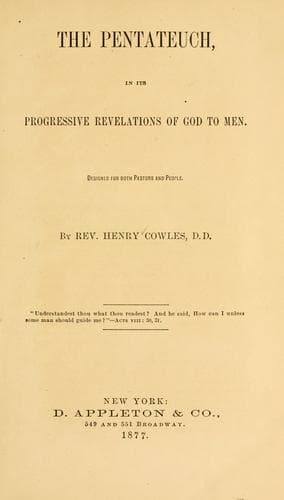
The Pentateuch, in Its Progressive Revelations of God to MenCowles, Henry
Religion
The Pentateuch, in Its Progressive Revelations of God to Men
Cowles, Henry
Bible. Pentateuch -- Criticism, interpretation, etc.
(c.) In some at least of these creative epochs, the work done demands
more time than twenty-four hours. For example, the gathering of the
waters from under the heavens into one place to constitute the seas
or oceans and leave portions of the earth’s surface dry land. Nothing
short of absolute miracle could effect this in one human day. But
miracle should not be assumed here, the rule of reason and the normal
law of God’s operations being never to work a miracle in a case where
the ordinary course of nature will accomplish the same results equally
well. We must the more surely exclude miracle and assume the action of
natural law only throughout these processes of the creative work
because the very purpose of a protracted rather than an instantaneous
creation looked manifestly to the enlightenment, instruction, interest,
and joy of those “morning stars,” the “sons of God” who beheld the
scene, then “sang together and shouted for joy” (Job 38: 7).――――
The greatness of the work assigned to the fourth day stringently
forbids our compressing it within the limits of one ordinary human day.
Especially is this the case if we understand the verse to speak of the
original creation of these light-bearers――the sun and the moon and the
stars also, and of their adjustment in their spheres for their assigned
work. Think of the vastness of the sun and of the numbers, magnitude,
and immense distances of the stars; and ask how it is possible that the
creation of these bodies could be either instructive or joyful to the
beholding angels if it had been all rushed through within twenty-four
hours of human time.――――This difficulty is in a measure relieved if we
suppose the fourth day’s work to have been, not the original creation
of these heavenly bodies, but only the bringing of them into the
view of a supposed spectator upon the earth――_i. e._ by clearing the
atmosphere so as to make these heavenly bodies visible. The question at
issue between these two constructions of the fourth day’s work must be
examined in its place.――――The amount of creative and other work brought
within the sixth day should be noticed. First, God created all the
land animals; then Adam; then he brought “every beast of the field and
every fowl of the air” to Adam to see what he would call them――which at
least must assume that Adam had attained a somewhat full knowledge of
language, and that he had time enough to study the special character
of each animal so as to give each one its appropriate name, and time
enough also to ascertain that there was not one among them all adapted
to be a “helpmeet” for himself. Then the “deep sleep” of Adam――how long
protracted, the record saith not; and finally the creation of Eve from
one of his ribs――all to come within the sixth day; for the creation of
Eve certainly falls within this day, being a part of the creative work,
and accomplished, therefore, before God’s seventh day of rest from all
his work began.
Public-domain text, read in full here on John Shaqi.
Reviews
Reviews
No reviews yet
Be the first to share your thoughts on this work.
Join the Discussion
Join the discussion
Sign in to leave a comment or review.
Sign InorCreate an account