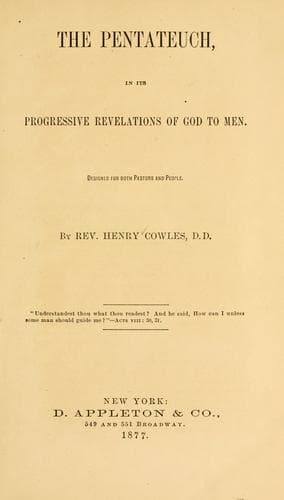
The Pentateuch, in Its Progressive Revelations of God to MenCowles, Henry
Religion
The Pentateuch, in Its Progressive Revelations of God to Men
Cowles, Henry
Bible. Pentateuch -- Criticism, interpretation, etc.
7. That this code was framed with the design of a special adaptation
to the Hebrew people appears in such facts as these, viz. that though
it went into immediate effect and continued in force during their
wandering life in the wilderness forty years, yet it anticipated
their ultimate residence in Canaan, especially in its land-law and its
provision for the entailment of real estate. Also it anticipated the
future demand for a king according to the usage of contiguous nations
and provided for this modification in the general government.
8. At the point where the administration of justice first appears,
the sole responsibility seems to have rested on Moses (Ex. 18). At
the suggestion of Jethro (as we have seen) important modifications
were introduced. Further modifications were made after the settlement
in Canaan. In consequence of the close connection between the church
and the state――the religious law and the civil――the same class of men
were to a great extent put in charge of both. The tribe of Levi became
the ministers of religion and the administrators of civil law as well.
Exempted chiefly from agriculture and from military service, they
became the learned class――the lawyers of the nation. “The priests’
lips should keep knowledge and they should seek the law at his mouth”
(Malachi 2: 7).
9. The question how far this divinely revealed code of law is
authoritative upon human legislators and should control legislation
in this Christian age, should be carefully considered. With no attempt
to exhaust this question, I may suggest briefly:――(1.) That the great
principles of this code should underlie every code of human law.
These principles must be good for all time――for man in his social and
civil relations every-where. For example, its doctrine of equity; its
law of love; its regard for the personal rights of life, chastity,
property; its doctrine of the essential equality of every man’s rights
before the law; and its assumption that the poor, being otherwise
defenseless, have special need of the protection of law, and should
be regarded therefore as the special wards of government and its
officers.――――(2.) As the moral law of the ten commandments is obviously
the compend and summary of the great principles which underlie this
Hebrew code, so should this moral law be the compend and summary of
the principles that should underlie every human code of law in whatever
age of the world and in whatever stages of civilization.――――(3.) As
the Hebrew code while accepting the supreme authority of the ten
commandments and aiming to embody and apply its principles did yet
allow to itself a certain latitude in adjusting its “precepts and
statutes” to the condition of the people, so may human legislators.
Lessons of wisdom may be drawn from this code in both these lines
of its example; viz. its fidelity to the principles and doctrines of
the perfect moral law of Sinai; and its careful adaptation of these
Public-domain text, read in full here on John Shaqi.
Reviews
Reviews
No reviews yet
Be the first to share your thoughts on this work.
Elsewhere in the archive
Join the Discussion
Join the discussion
Sign in to leave a comment or review.
Sign InorCreate an account